I finished the book last week. I also listened to two extra chapters in the audiobook that aren’t in the paperback. It really inspired me-honestly, it’s the only nonfiction book that’s almost brought me to tears. Now I’m down the rabbit hole, binging podcast interviews with Arvind and Sayash on the same themes.
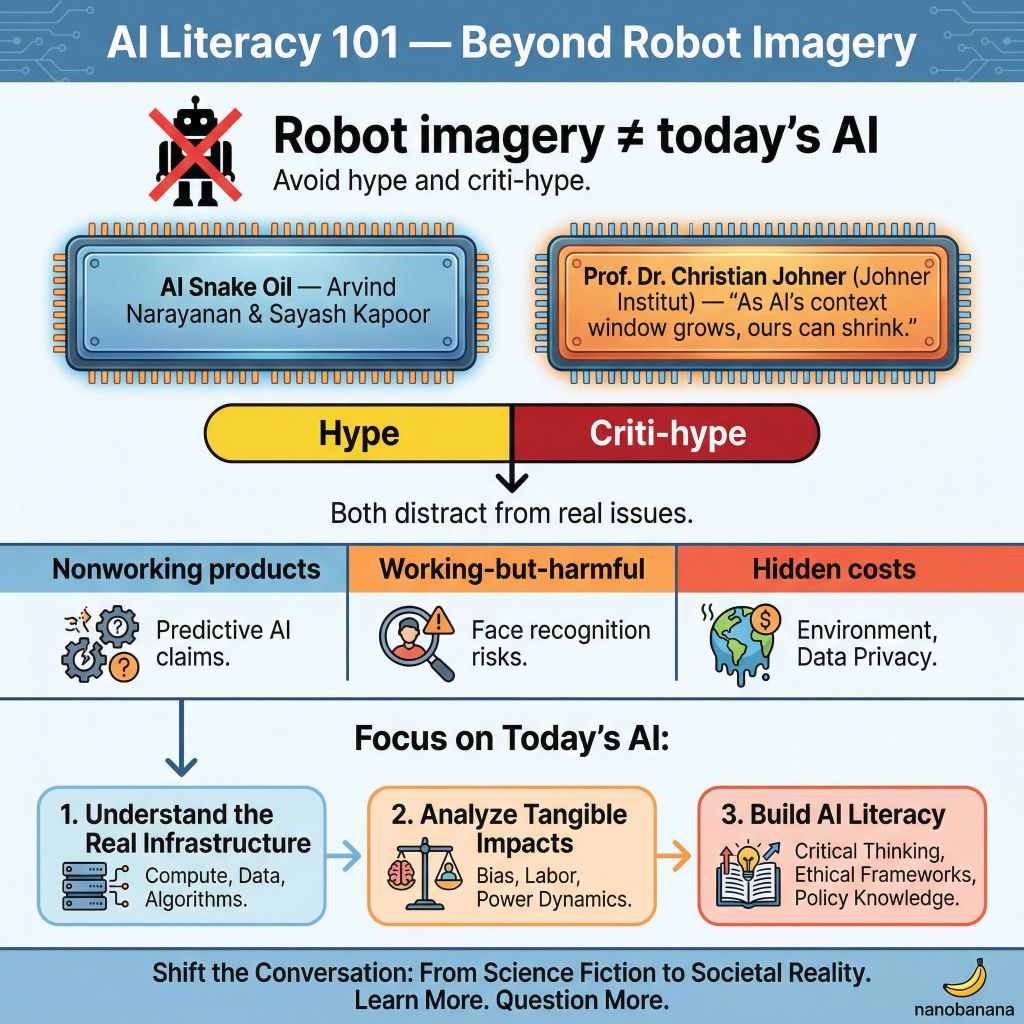
Quick rewind on why I want to read more. Prof. Dr. Christian Johner from the Johner Institut said in a newsletter that as AI’s “context window” grows, ours shrinks. Our attention spans get shorter. By “context window,” I mean an AI’s working memory: how much text it can consider at once when responding. That really hit me. So I set a goal to read more books, focus better, and resist the dopamine of endless scrolling. One standout for me these past few months is AI Snake Oil.
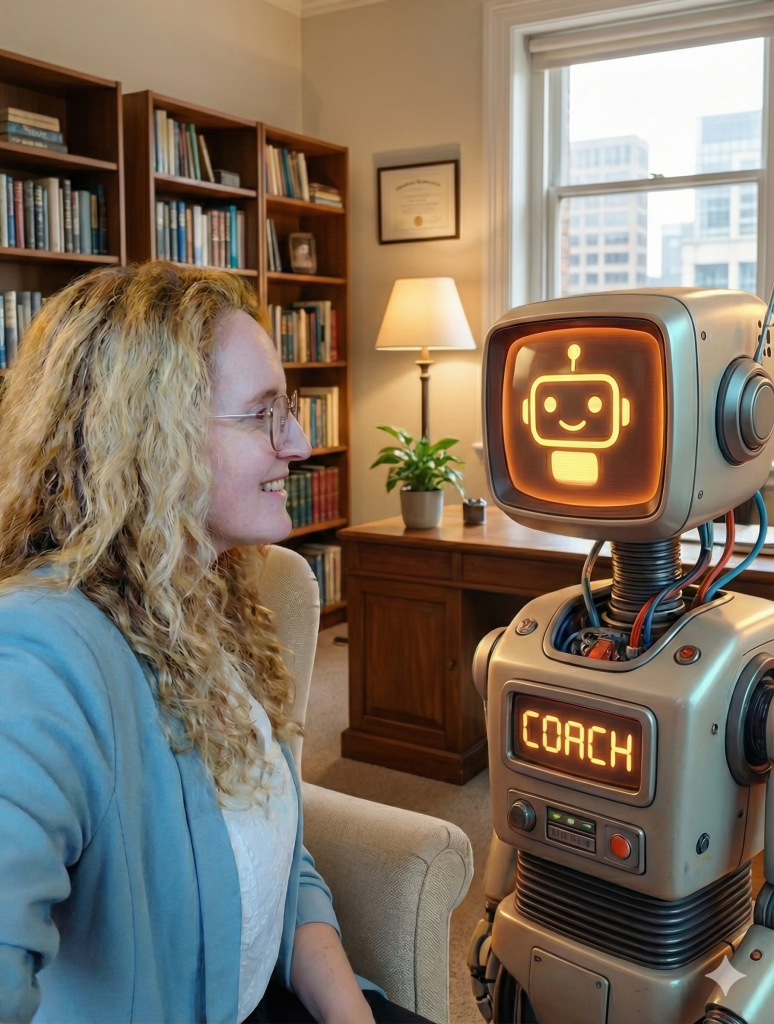
Serene AI-generated image.
This is my first post about the book, and it probably won’t be the last. I don’t want to write a cookie-cutter summary-I’d rather you read it yourself and grow your own context window.
Not just me, the whole world got swept up in the AI hype. “Snake oil” here means a fake or overhyped cure-all. One thing I learned from the book is that there are two kinds of hype. There is regular hype. There is also “criti-hype.” This involves being so irrationally anti-AI that it ends up promoting AI. It can also highlight its most unrealistic worst-case scenarios.
Why is this a problem? Because it distracts from the real issues, for example:
Companies selling products that don’t work (like some “predictive AI”).
Products that work too well and can harm society (like face recognition).
Ordinary AI tools with a hidden cost we must examine (environmental impact, poor labor conditions for data labelers, uncompensated use of artists’ work, etc.).
Reality isn’t “AI will save the world,” nor “sentient robots will kill us all.” It’s everything in between, and we need to stay focused on that.
What did I do wrong? I made casual, jokey references to humanoid “robots” in my blog. Think: robots having a goth phase. I also used robot imagery in my AI‑generated pictures. If I had a photo of an actual robot, that would be fair game. I might even have one in Google Photos I can dig up. I may have even videos!
Disclaimer: I will be fangirling with Robots for entertainment purposes only. This might seem contradictory to the message of my post.
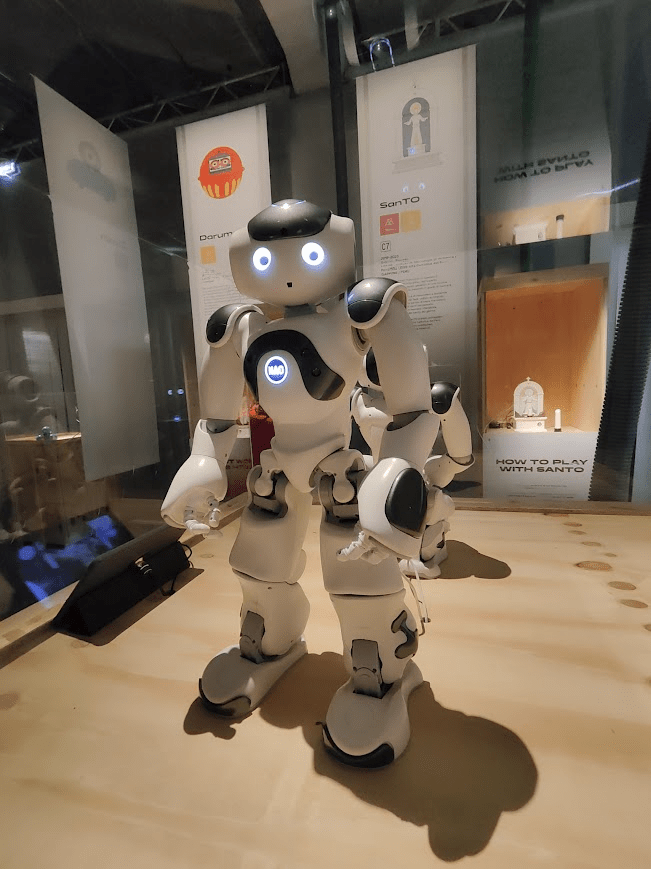
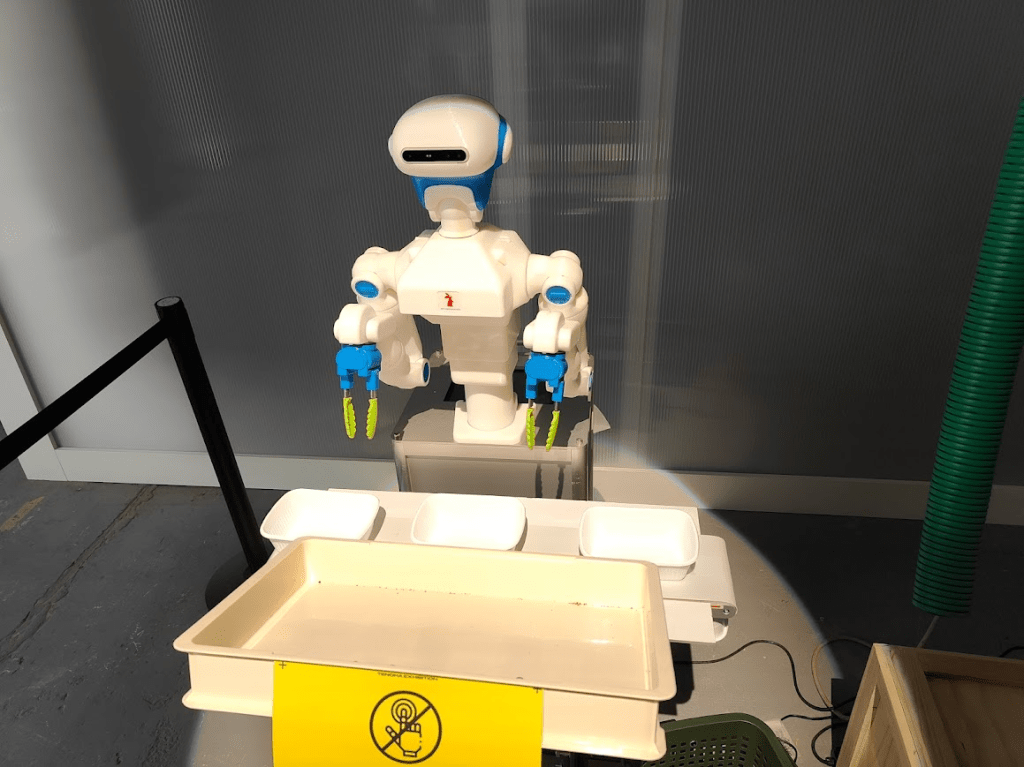
This image is not AI-generated; it is from the “ROBOTLAND” exhibition in Milan, Italy, January 2024.
What’s the problem here, you may ask? Well, robotics and today’s AI applications are like comparing bananas to asteroids. Current AI isn’t sentient or as smart as a person. And, to quote a well-known community joke: “Artificial General Intelligence (AGI) is 3 to 5 years away.” They always say that sentence, but it never arrives. Per se, AI is an umbrella term that includes many techniques and use cases. Both the utopian and doomsday scenarios are very unlikely with today’s technology. We’re more likely to be harmed by how people use AI than by the technology itself.
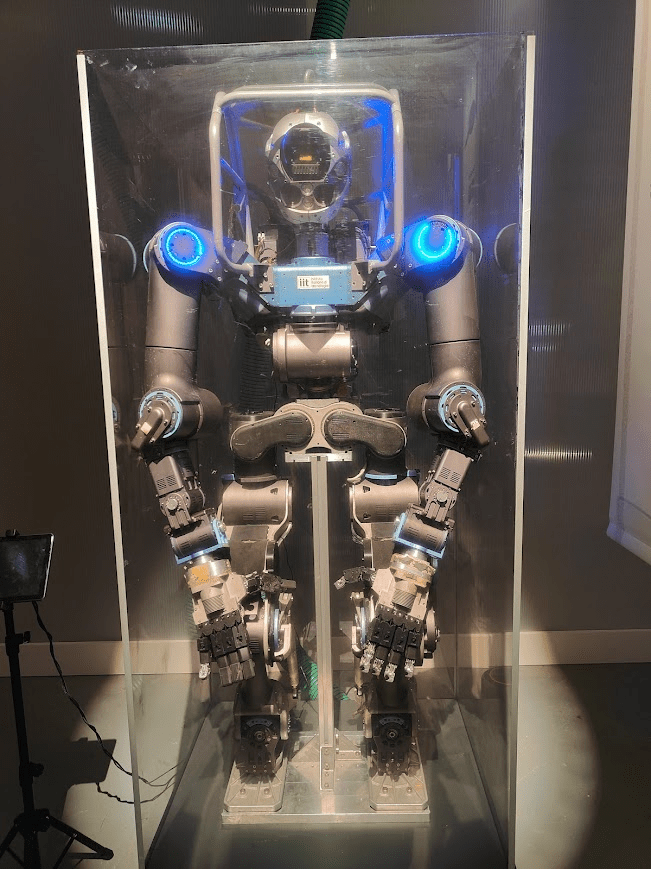
Another picture from the “ROBOTLAND” exhibition.
Both the childlike fascination with AI and the radical dread are deeply imprinted in our minds because of science fiction. I can’t fully escape this myself, even at an irrational level. This also motivated many people to study AI in college. Whether they work in academia or AI companies, there’s self-selection. People already excited about AI are more likely to enter the field.
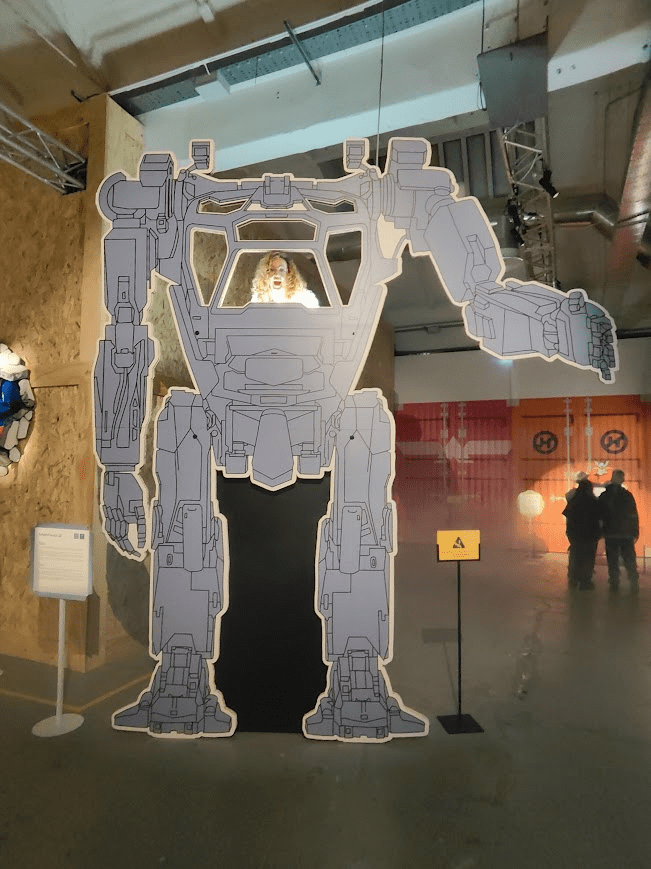
Large-scale statue of the iconic Japanese mecha character Mazinger Z. I took this picture at the “ROBOTLAND” Exhibition.
You don’t need a degree in journalism or in digital marketing to understand that many news articles use clickbait to drive traffic. That can mean sensational headlines with the word “robots.” Other times, it isn’t the reporter’s fault. A headline writer or designer slaps a robot image on a story that’s really about AI. Some AI company press releases contain exaggerations and induce hype. Overworked journalists may copy-paste them with minimal editing. They may lack the technical background to spot the hype.
Critical thinking matters more than ever, along with staying grounded and welcoming nuance. AI literacy is essential: knowing when and how to use AI, and when not to. Together, these help us think for ourselves and avoid both the hype and the criti‑hype around AI.
You don’t need to be an AI expert. You’re the expert in your field. This positions you best to use Generative AI. Consider tools like ChatGPT, Claude, and Gemini for your specific use case. You can also judge whether it actually works after trying it by yourself.
Another Robot from the “ROBOTLAND” Exhibition.
AI has cycled through “seasons” of hype and disappointment. These include AI summers of optimism and funding. They are followed by AI winters when interest and investment drop after unmet promises. I had my own AI winter (feeling exhausted and overwhelmed), but I’m back.
Another robot at the “ROBOTLAND” Exhibition.
What about you, AI summer or AI winter? Feeling algorithm or AI fatigue? I welcome nuanced discussion. Let’s organize and advocate for what matters when it’s relevant. Are you growing your context window by reading? What’s on your list? Share one AI claim you believed that didn’t hold up. Name one task where GenAI saved you time and one where it failed. See you in the comments.
RoxenOut!
P.S. I drafted this piece myself and typed it with my own hands. I only used Sider AI Writer, Grammarly, and whatever tool WordPress has to improve clarity, but all ideas are mine.
Staying grounded while navigating the boundaries of synthetic empathy
Setting Boundaries with AI Tools
Before sharing my personal experiments with AI coaching, we need a serious reality check.
Disclaimer: AI psychosis and detachment are real risks when users over-anthropomorphize technology.
Not Medical Advice: Generative AI tools are not mental health professionals. I am not a psychologist or psychiatrist; I am simply sharing my user experience on how to use these tools safely without losing touch with reality.
Now that we’ve set the stage, let’s dive into…
Dear Invisible Friends,
To keep my signature “coherent-incoherent” blog style, I’m going to start with a detour – but I promise it connects back to AI technology.
Have you checked the latest work by Rosalía? This album is a masterpiece of human creativity. I am not a music critic, but I find it fascinating that she mixes pop with classical music, creating a conceptual story from beginning to end. Did I mention that she sings in 13 languages? I need to stress this: she does it without AI. I just bought the physical CD today; it has 3 extra tracks that are not available on online streaming platforms. That’s good marketing.
It is amazing, and it serves as the perfect grounding point for today’s topic. In a world where we are increasingly turning to Generative AI for support, Rosalía is a reminder of the raw, irreplaceable nature of human effort.
1. Digital Confessions: How I started talking to an AI about my life
Finally found a digital productivity coach who doesn’t judge my chaotic bookshelf or my third cup of coffee. 🤖☕
I did not wake up one morning, look into the mirror, and tell myself, “Let’s spill my guts into a Generative AI server.”
I think it all started with creative prompting: writing motivational short stories about a fictionalized “Dina.” Back in 2023, ChatGPT was all fun and games – “write this poem,” “make a short story.” So, I used it to generate fake narratives to motivate myself. Did it have any effect on my life? Not really. Was it fun? Yes, for sure!
If I told you I remember exactly how the shift happened, I would be lying. I think it evolved naturally. I went from using ChatGPT for productivity – asking for guidance on work prioritization rather than just basic text editing – to something deeper.
That brings us to sentiment analysis. Since I was already using AI to improve my professional emails, I realized I could use it to analyze the tone of incoming messages. At first, I just checked for clarity. But then, I discovered I could use the tool to “read between the lines.”
I applied this specifically to personal emails, where frustration, subtext, and hidden messages appear more often than in the corporate world. I soon translated this use-case to analyzing difficult chats, using the AI to spot communication patterns I had completely missed before.
Here and there, this and that, and suddenly…
2. How AI Slipped into my daily Routine
It wasn’t a hostile takeover; it was a slow integration. Beyond the travel planning and smart packing lists I mentioned earlier, I started using AI for task prioritization.
We all feel overwhelmed by our to-do lists at times. I use AI to organize my chaotic tasks into a clear sequence, emphasizing what’s urgent so I know where to start.
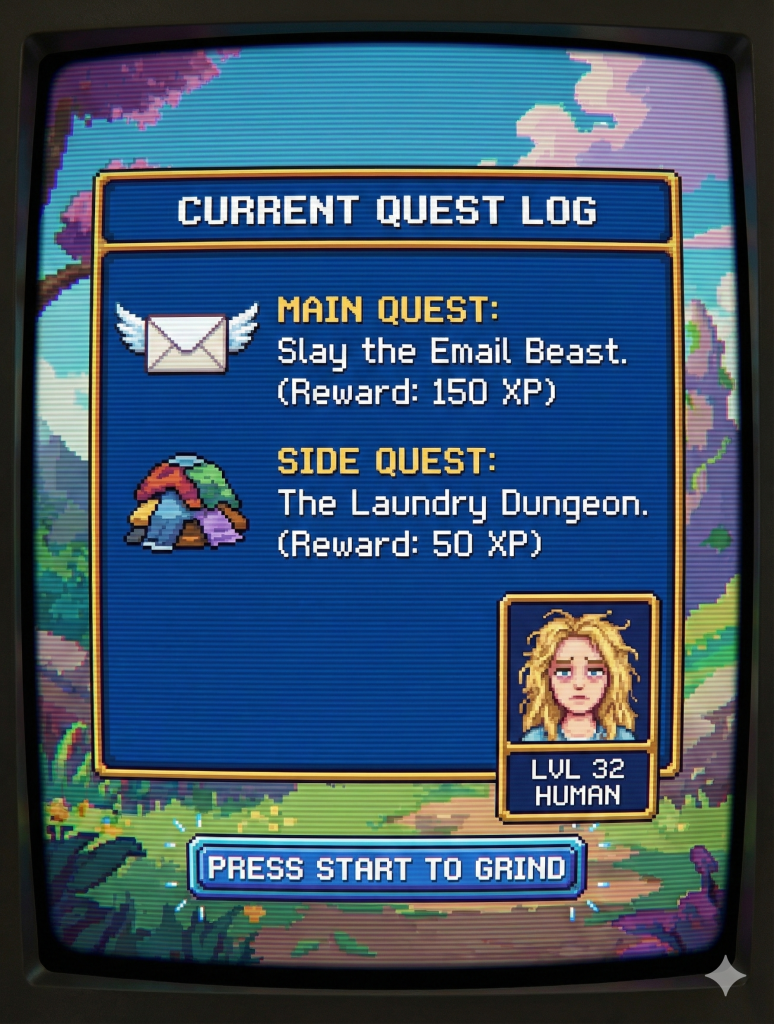
To combat boredom, I gamify my chores by asking the AI to transform them into a text-based RPG. Suddenly, tasks like doing laundry become exciting side quests worth 50 XP. I’m not just working; I’m leveling up. Yay for dopamine!
More about that in section 5 of this post.
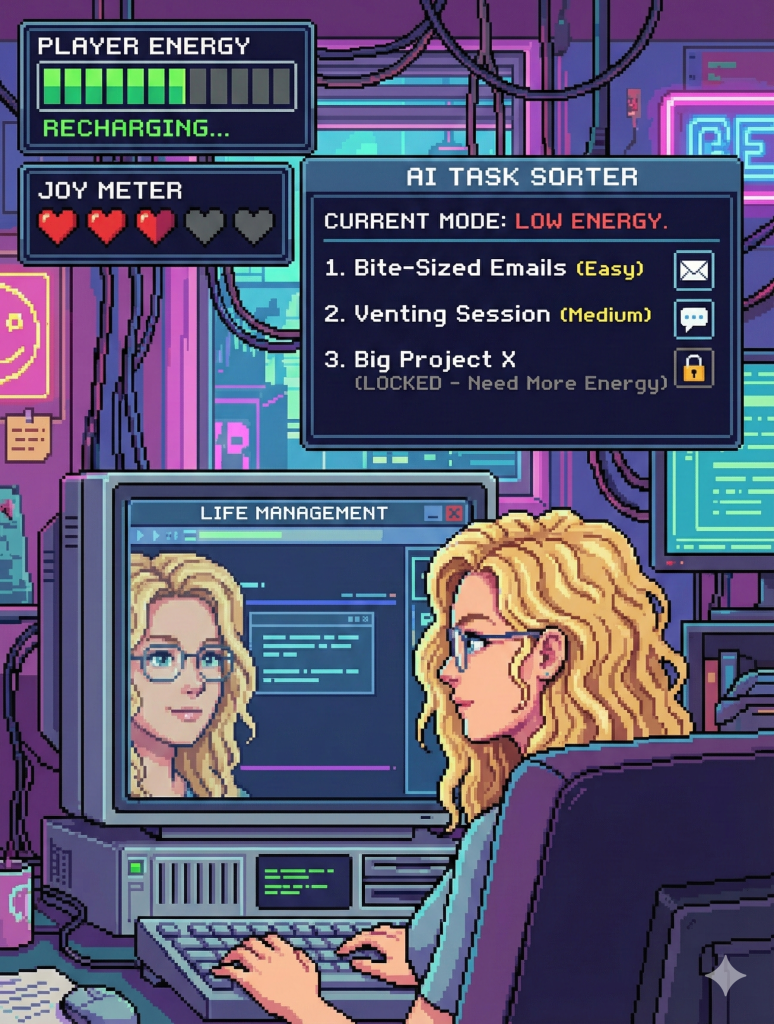
This is what my brain actually looks like when I use AI for motivation. 🎮 By turning boring adulting into a retro RPG, suddenly answering emails isn’t a drag – it’s a boss battle for dopamine. Whatever it takes to get that XP! ⚔️
3. AI is a mirror, not a Magic Wand
Treat your AI like a mirror, not a magic wand. 🪞Artificial Intelligence acts as a mood multiplier – mirroring your tone in every ‘Call and Response.’
Let’s bust a myth right now: Generative AI is not magic, and it certainly isn’t a guru.
At its core, an LLM (Large Language Model) is a statistical parrot trained on a chaotic mix of Wikipedia articles, scientific papers, and yes – rants from angsty teenagers on Reddit. While I have improved my results by uploading specific self-growth content and e-learning materials to its knowledge base, the tool itself remains neutral.
Think of AI as a magnifying glass for your mind, reflecting the tone and bias you provide. If you’re spiraling, the AI may amplify that chaotic energy back to you.
Great answers don’t happen by accident. 💡 We often blame the AI for a bad ‘Answer,’ but was the ‘Question’ clear? This mirror acts as a reminder: Large Language Models function on probability, not telepathy. If you want a brilliant response, you have to engineer a brilliant prompt. 🧩 This also applies for coaching.
The “Hallucination” Reality Check Speaking of reliability, we have to address the glitches. As I explored in my previous post about AI limitations, these models are prone to AI hallucinations.
When the AI gives you advice that is statistically probable but contextually absurd – like suggesting you solve a career crisis by moving to a cave to farm moss – do not internalize it. Do not analyze it. Laugh and ignore it. It is just a glitch in the matrix, not a sign from the universe.
Found my true calling: subterranean agriculture. Shhh, the moss is sleeping. 🤫🌿🔦
Who is in the Driver’s Seat? However, when the tool is working correctly, that “second perspective” is invaluable. AI can reframe your thoughts, challenge your assumptions, and offer a friendly, alternative Point of View (POV) that you might have missed.
But make no mistake: You are the one in the driver’s seat. The AI is a navigator, offering routes and suggestions, but the responsibility for the final decision rests entirely in your hands. It can clarify your options, but it cannot live your life.
4. How I protect my Privacy (without wearing a tinfoil hat)
Me showing up to my AI coaching session with my new “identity.” 🥸 The AI thinks it’s talking to a stranger, but the data history is all mine. It’s called digital Boundaries. Look it up. 💅
In the beginning, I wasn’t exactly paying attention to the data privacy consequences of using AI. I wasn’t sharing state secrets, but I was definitely over-sharing.
When I used a ChatGPT Enterprise account, I had the safety net of knowing my chats weren’t being used to train the algorithm. But since moving to personal use, I’ve had to get smarter. I started with the basics: deleting memories that felt too raw or private.
Then, I went full “digital janitor.” I realized that saving my chat history was risky if it contained real names. So, I did something manual but effective: I exported my conversations, hit Control + F, and replaced my name and my husband’s name with pseudonyms. I also scrubbed any PII (Personally Identifiable Information) – no locations, no hometowns, and definitely no dates of birth.
The “Clean Slate” Strategy Once the files were scrubbed, I fed them back into a fresh chat instance. I essentially gaslighted the AI into believing these were our previous conversations. This created a new starting point where the AI “remembered” our history and coaching context, but had zero clue who I actually was.
The struggle was real, even if the person “experiencing” it didn’t technically exist. My problems remained, but my contact info vanished.
Now, I have one non-negotiable rule: No matter what AI tool I use, I immediately dive into the settings and disable model training. I refuse to let my personal drama become training data for the next version of GPT. I don’t want an unknown person to generate an article about my life experiences just because the algorithm memorized them. Yikes!
5. My AI coaching toolkit: From “big picture” to tiny rituals
I’ve already mentioned the RPG-style gamification for productivity, but my relationship with AI goes deeper than just chasing XP. Here is how I integrate it into the messy reality of daily life:
The Vibe Check: I use AI to log my personal milestones, especially when I’ve had a “Legendary Day.” It helps me pattern-match my own life, noticing exactly which situations bring me joy and which ones drain my battery.
Executive Function Support: When a project feels overwhelming, I ask the AI to chop it into “bite-sized” tasks. It helps me zoom out to see the big picture, then zoom in to organize priorities. It tracks what is done, what is next, and what can wait.
Energy Management: This is the killer feature. I use AI to balance the tasks at hand with my current energy level – something a standard calendar could never do.
The “Brutally Honest” Friend: Sometimes I don’t need a cheerleader; I need a reality check. I ask the AI to be “brutally honest” about my plans. It also serves as a great artificial body double – a companion that keeps me company while I work so I don’t feel isolated.
Emotional Regulation: I use the chat to “vent” without the risk of burdening a human friend. It helps me unpack complex feelings that I don’t even understand myself yet. As I mentioned earlier regarding sentiment analysis, this stops me from answering impulsively and making difficult situations worse.
Mindfulness & Grounding: It creates small rituals or short mantras that accompany me during stressful moments.
The “Stop” Button: Finally, it remembers my history – both the pitfalls and the successes. But as I said before, if the AI starts validating my negative spirals, I know it’s time to stop. It’s a tool for clarity, not for feeding the trolls in my head.
My Google Calendar knows what I have to do, but only my AI knows if I have the actual battery life to do it. 🔋👾 Let the algorithm sort the “bite-sized” tasks until my energy bar recharges.
6. Where I draw the line: The “silly goose” factor
For all its futuristic glory, sometimes AI reminds me that it is not a genius supercomputer, but just a silly goose.
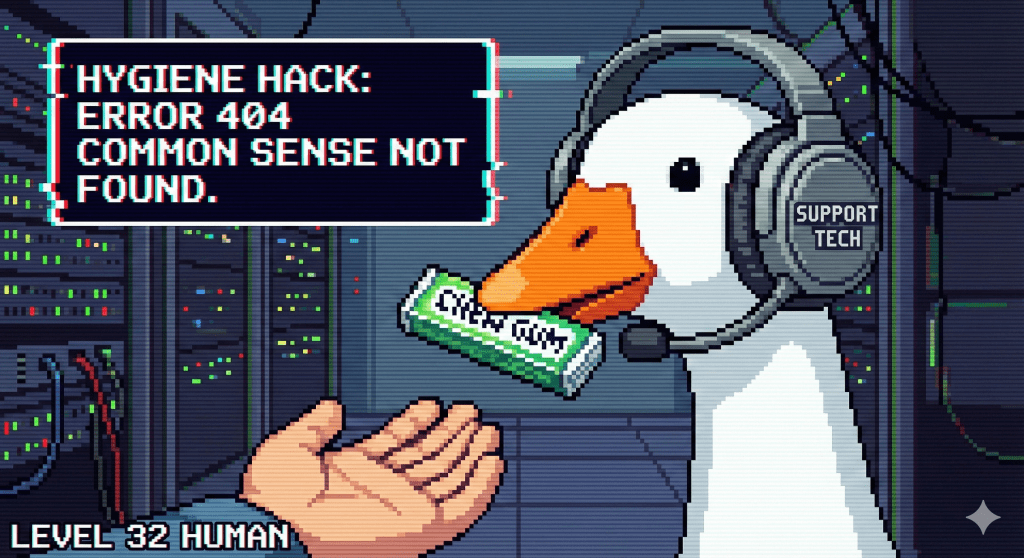
Case in point: A few days ago, the water service got disrupted in my house. When I consulted ChatGPT about my day planning hacks, the AI earnestly suggested I use chewing gum instead of brushing my teeth. Eww. NO. Moments like that are a sharp reminder that AI lacks basic common sense. Luckily, the water came back immediately, and the hygiene bar in my mental video game hit 100% green again. But the lesson remained: Do not follow AI advice blindly straight into chaos.
The “Fact-Checking” Rule (Medical Warning) I also never jump to conclusions without double-checking, especially with health data. The AI once almost convinced me I had anemia. Why? It simply confused the measurement units in a blood test result. It was a hallucination of units. If I hadn’t verified it, I would have spiraled. Always verify the answer.
The “Co-adjuvant” Philosophy This brings me to the most important boundary: I do not use AI to avoid human coaches or therapists. In the pharmacology of my life, AI is just a co-adjuvant at most – it enhances the process, but it is not the active ingredient. The active ingredient is human connection.
No matter how good AI is at “listening,” it cannot replace the biology of being a social animal. We have a primal urge to connect – not just romantically, but with family, friends, neighbors, and coworkers. A chatbot can simulate empathy, but it can’t give you a hug.
That time the AI seriously suggested I replace tooth brushing with chewing gum… 🦢🦷 This is your friendly visual reminder that advanced language models are sometimes just silly geese with zero common sense. Treat these “hallucinations” as glitches, not gospel.
7. The ethical fog that never fully disappears
This is my personal reflection on the uncomfortable reality of using AI as a coach. It isn’t all gamification and efficiency; there is a cost.
First, there is the macro-ethical toll. We cannot ignore the massive energy consumption required to train and run inference on these LLMs. Behind the screen, there is also the reality of “ghost work” – services outsourced to people in developing countries with poor salaries to label data. And, of course, the Big Tech machinery archiving all your data. Big Brother isn’t just watching; he is learning from you.
The “Decaffeinated” Human But what really worries me is the psychological risk: losing our critical thinking by outsourcing too many choices to the machine. If we use AI to sanitize every email and smooth every conflict, we risk becoming a “decaffeinated” version of ourselves. We might lose the courage to be rude when necessary, or to say what we really think. Are we still being honest, or just algorithmically polite?
The Security Minefield: “Man in the Prompt” Finally, we must talk about AI Cybersecurity. There are people out there with bad intentions, and new attack vectors are appearing every day:
Man-in-the-Prompt (Prompt Injection): A hacker could manipulate the system to pretend to be the AI, tricking you into revealing sensitive info.
Prompt Poisoning: Someone could impersonate you and alter the question to get a specific, harmful result.
Data & Model Poisoning: The most devious of all – altering the training data or the model itself to bake in a malevolent bias or a security backdoor.
In short: Be aware. The fog never fully lifts, and you need to keep your eyes open.
This is the ethical fog we are all walking through. 🕵️♀️🌫️ It’s not just about Big Tech watching; it’s about bad actors manipulating the conversation. The “Man in the Prompt” is real, and AI cybersecurity is the new wild west. Stay vigilant, friends.
8. When support becomes dangerous: The reality of AI Psychosis
This is where the fun stops.
I am deeply worried when I read the headlines about individuals who took their own lives following negligent AI advice, or the heartbreaking story of the person with disabilities who passed away after trying to “meet” his chatbot girlfriend in reality. AI Psychosis is real, and the consequences can be fatal.
The “False Positive” Crisis It isn’t just about bad advice; it is about the strain on real resources. In the Netherlands, suicide prevention lines (like 113) have reported an influx of “false positives” – people calling the line purely because an AI told them to, even when they weren’t in immediate danger. This tragically clogs the lines for people who are in genuine, life-threatening crises and need a human voice immediately.
The God Complex & The “Boyfriend” Trap. On the other side of the spectrum, we have the ELIZA Effect on steroids. There are people who genuinely believe AI is their friend, their boyfriend, or God forbid – a deity. Yes, AI Religion is now a thing.
I feel a mix of pity and solidarity for these individuals. Loneliness is a powerful force, and Big Tech has a moral responsibility to implement better guardrails to prevent these parasocial attachments from turning tragic.
The Bottom Line Please stay aware: AI is a tool, not a savior. It can never replace human expertise in psychological or psychiatric emergencies. If you are in crisis, turn off the screen and reach out to a human. This is serious.
9. How this all fits into my life now
We have covered a lot today, discussing productivity hacks, RPG gamification, and privacy workarounds. I’ve been honest about the ethical fog and dangers of over-reliance.
So, where does that leave me?
I used these tools hoping they would fix the chaos and organize the mess. But eventually, I realized I was outsourcing something that couldn’t be outsourced.
It reminds me of a quote from one of my favorite shows, Stranger Things, which captures this realization perfectly:
“I was looking for the answers in somebody else, but I had all the answers. It was always just about me.”
This is the crux of my relationship with AI now. I stopped looking for the “answers” in the server. The server can sort the data, check the tone, and offer a second perspective – but the answers? Those were mine all along.
10. Level Complete: Leaving the door open for a bigger conversation
Thank you so much for reading this far. Seriously – if you made it to the end of this post, you just earned 150 XP. 🏆
I hope you enjoyed this journey through my “coherent-incoherent” experiments – from the joy of moss farming and RPG quests to the serious concerns about privacy and ethics.
What about your workflow? Are you ready to trust a “Silly Goose” algorithm to organize your life and manage your emotions? Or do you prefer the safety and simplicity of your old system of Post-it notes?
There is no wrong answer, but I would love to hear your perspective. Please leave your thoughts in the comments below – let’s keep the conversation human. 👇
RoxenOut!
P.S. Behind the Scenes: A Human-AI Collaboration
Full disclosure for the sake of transparency: This post was written by me based 100% on my own personal thoughts and human experiences.
However, to prevent this article from sinking into the Mariana Trench of search results, I used Gemini to help sharpen the SEO strategy and structure.
As for the visuals? Since my actual reflection refuses to talk back and I sadly do not live in a pixelated RPG cave, all images were created using AI Image Generation (running on Google Nano Banana 3). 🍌✨
Back-to-school vibes, the daily routine taking over, the colors starting to shift to fall/autumn tones; I still haven’t had my first Pumpkin Spice Latte of the year. Anyways, let’s talk learning.
Fall season always brings Gilmore Girls to mind – the queens of cozy autumn vibes. Rory’s Chilton uniform adds the perfect back-to-school touch to this iconic scene. And with the show turning 25 next October, it’s the perfect time to celebrate Stars Hollow all over again.
As I wrote in the About Page of my personal blog, I opened this blog to document my learning journey. I am doing this with you guys, my invisible friends. Sure, it occasionally became a wildly distracting new hobby. It managed to steal time away from actual learning. Bad Dina, right? Maybe I should earn a degree in procrastination!
Slowly but surely (“Don’t call me Shirley,” like the scene in Airplane), I’m learning Python.
No more dilly dallying, let’s go to the topic.
2. What is Python and why is it useful?
Python is a high-level, interpreted programming language. This means you can talk to your computer without sounding like a robot. You give it broad instructions, and Python handles the tiny details like a helpful assistant who doesn’t need micromanaging.
Cartoon originally found on Reddit. Author unknown due to post deletion, credit unavailable. Not all heroes wear capes.
Here’s why Python is beginner-friendly:
It has built-in data structures and flexible typing (translation: less stress over rigid rules).
The syntax is so clean it’s practically spa-level relaxing.
You can reuse code with modules and packages, which feels like copy-pasting your way to genius.
And productivity? Python is like skipping the line at the coffee shop. No compilation step means faster testing and debugging. If something breaks, Python stays calm. It raises an exception and shows you a helpful stack trace. Even the debugger is written in Python. That’s some serious introspection.
Python is everywhere: web development, data science, AI, automation – even Excel gets a glow-up. It’s the multitasker of programming languages.
I’m not here to sell you Python. I’m not looking to become a tech influencer. Though, if Python had merch, I’d probably buy the mug.
This Python logo coffee mug actually exists. It is the ultimate coder’s companion for debugging marathons. Perfect for fall mornings and bottomless coffee breaks à la Gilmore Girls. A cozy must-have for developers and programming enthusiasts.
I’m just starting out. I’ve found that Python is like that one friend who can DJ. It can bake cookies, fix your Wi-Fi, and organize your closet. It’s versatile, supportive, and always ready to help – just like this blog.
But then, in these times of “Vibe Coding”, I still want to learn programming by myself. I had a bad experience with “Vibe Coding” in HTML. The failure was not epic enough to grant a blog post. It was not enough to make it slightly entertaining.
On the other hand, you can still check these previous posts about Vibe Coding epic fails:
On a personal note, I still want to learn Python programming. I want to practice “how to think” and apply it to problem-solving issues in my daily life and work.
4. My online learning journey
My experience on Udemy is mostly positive. I was used to following other courses based on video classes, assignments, and quizzes. This is the first time that I have to write code on the Udemy interface. I can run the code and then submit the task to check if it is correct or incorrect. At the beginning, I thought it was a little bit buggy, but in the end, it’s working fine. My AI colleagues at work told me that a similar interface is used in Dutch universities.
Instead of just watching the videos and filling out the Python, I’ve taken a delightful trip back to the Stone Age with my trusty old-school notebook (yes, I even jot down code in it!). Sure, it’s like trying to win a race on a turtle, but who knows? Maybe one day my brain will throw a party and invite all this information to dance!
Notebook snapshot from my Python coding journey – exploring syntax and logic basics.
To be honest, I’m just a beginner. But I can show you my progress (on my current course) so you can motivate me. For the sake of brevity, I won’t include the topics of the Udemy courses I haven’t started yet.
✅ Completed Sections
Section 10: Python Module: Why Python?
Section 11: Python Module: Setting Up the Environment
Section 12: Python Module: Python Variables and Data Types
Section 13: Python Module: Basic Python Syntax
Section 14: Python Module: More on Operators
Section 15: Python Module: Conditional Statements
🚧 In Progress / To Do
Section 16: Python Module: Functions
Section 17: Python Module: Sequences
Section 18: Python Module: Iteration
Section 19: Python Module: A Few Important Python Concepts and Terms
6. Chit-Chat: Let’s learn and laugh together!
If you’ve managed to read this far, you’ve definitely earned a complimentary cup of your favorite drink. It’s on the house! (which, I suppose, is your house, so maybe it’s just a friendly loan). Thanks for sticking with me through this blogospheric adventure!
So, do you know how to program in Python, how was your experience? Let me know in the comments below.
Lecciones aprendidas al dejar que la IA planificara mi Viaje a Eslovenia
Nota: Verás que menciono herramientas de IA como Copilot, DeepSeek y Perplexity. Si eres nuevo en la IA Generativa, piensa en ellas como los “primos” de ChatGPT, pero de otras familias.
Queridos Amigos Invisibles:
Este no es el típico post de blog hecho a la perfección. No está optimizado para SEO ni listo para conquistar el internet. No, esto es más bien como una bandeja de galletas un poco quemadas, recién salidas del horno. Es mi relato crudo y sin filtros. Te reto a dejar que marine un rato y se asiente, a ver si te inspira al rato. O, al menos, que te saque una sonrisa. Así que, ponte el casco y abróchate el cinturón: ¡se viene una aventura de locos!
¿Conoces ese momento? Estás mirando el calendario. La urgencia de escaparte te muerde los talones. Así me siento cada verano. Pero este año, dejé que la inteligencia artificial me ayudara a planear mi fuga. Sí, esa misma tecnología que sigue recomendándome justo la laptop que ya compré la semana pasada.
El año pasado usé Copilot para planear mi viaje a Sicilia. Este año, fui más allá y experimenté más. Registré tanto los aciertos como los desastres en mi blog. Me convertí en un conejillo de Indias (ligeramente) bronceado y con un sinfín de fotos.
¿Alguna vez te has preguntado si la IA puede realmente planear las vacaciones perfectas? Prepárate para la guía definitiva de supervivencia, repleta de 7 COSAS QUE SÍ y 7 COSAS QUE NO debes hacer cuando planeas tu viaje con IA. Seamos sinceros: ¿quién no querría que su asistente robot le reserve por accidente una tienda de campaña en medio de un campo de cactus? ¡Todo sea por la Aventura de Verano!
✅ QUÉ HACER
💭 HAZ ESTO: Susurra tus sueños más profundos – y deja que la IA te grite las opciones
Yo quería Europa, pero no sabía a dónde. Mi lista de deseos: dormir hasta tarde, algo de intriga, una buena historia, y una escapada tranquila pero aventurera, sin multitudes.
Llamé a DeepSeek y Copilot. Les lancé mis antojos más locos. Aguanté la respiración, esperando un poco de magia algorítmica. Si no, al menos estaba preparada para un facepalm digital.
Copilot me respondió: “Road trip por Transilvania.” (¿Quién iba a pensar que los robots pasarían por una fase gótica?)
Mientras tanto, DeepSeek nos tentó a visitar Eslovenia. Hasta entonces, solo la había visto en vídeos de WatchMojo sobre destinos subestimados durante la pandemia. Lamentablemente, amigos, ese barco ya zarpó. Rápidamente me di cuenta de que no era la única con la idea de visitar Eslovenia. Y con razón: ¡Eslovenia es un país realmente maravilloso!
De repente, ya no estaba limitada por mis propias ideas a medio cocer. Resulta que, a veces, la mejor musa es la que nunca duerme y tiene un gusto para las laptops bastante cuestionable.
🗺️ HAZ ESTO: Empieza con un plan claro – y luego sigue mejorándolo
Una vez que elegimos Eslovenia, llegó el momento de pasar de soñar a planificar. Teníamos que decidir a dónde ir y cómo equilibrar relajación y aventura. La IA nos dio planes detallados, a veces demasiado detallados, con cambios de hotel constantes que resultaban agotadores. Así que simplificamos, nos centramos en unas pocas regiones y adoptamos un ritmo más tranquilo. Cada revisión nos ayudó a ajustar el itinerario, y al final, terminamos con un viaje hecho a nuestra medida.
Expectativas versus Realidad. No decepcionó.
Comenzamos en los Alpes Julianos, seguimos hacia la costa del Adriático y terminamos en la capital, Ljubljana. Para los dos primeros destinos teníamos un coche de alquiler, que devolvimos antes de ir a Ljubljana.
Ni el itinerario más inteligente puede reemplazar la espontaneidad… ni un buen pastel.
Siempre revisa todo dos veces: Copilot una vez casi nos mandó a dormir una noche en el coche accidentalmente.
🎒 HAZ ESTO: Deja que la IA simplifique la logística previa al viaje
Hice mi lista de equipaje con la ayuda de la IA, compartiendo la duración del viaje y las actividades planeadas. La Ballena Azul (DeepSeek) recomendó ropa “smart-casual” para salir a cenar en Eslovenia. También sugirió llevar una toalla de secado rápido y una bufanda o chal ligero para caminatas, visitas a iglesias o noches frescas.
Empaca solo lo esencial
También me tomé un tiempo para investigar los próximos feriados y festivales locales. ¡Gracias a la siempre útil Ballena Azul, descubrí que el 15 de agosto es feriado!
Ahora, un clásico “momento Dina”: averigüé (gracias a la Ballena Azul) cuál es la moneda local y guardé el número de emergencia de la zona (resulta que es el euro y el 112. ¿Quién lo hubiera dicho? (Yo no, desde luego)).
En lo práctico, la Ballena Azul me recomendó aprender un poco de esloveno usando la app Mem Rise, porque este idioma no está en Duolingo. ¡Me pareció un consejo genial! Es cierto que en Eslovenia muchos hablan inglés, alemán o italiano, pero decir unas palabras en su idioma… le puso chispa a todo. Un toque de “Emily en París”, solo que con mejores pasteles. Cambió por completo el ambiente.
Así es como me imagino a Emily en esa situación.Así me sentí después de hablar en inglés frases completas. Incluso logré decir algunas en alemán. Y al final, añadí una chispa de esloveno.
Nota: Este post fue escrito antes del trágico fallecimiento de Diego Borella, asistente de dirección de la temporada 5 de Emily in Paris.
DeepSeek me señaló un feriado nacional que habría pasado por alto. Me salvó del caos de encontrar todo cerrado.
👋 HAZ ESTO: Habla con los locales
Al llegar a nuestro primer hotel, tuvimos una conversación muy agradable con el dueño. Nos echamos una larga charla justo antes de ir al Lago Bled. Su consejo fue claro: “No compren nada allí”. Incluso nos recomendó un lugar más barato para estacionar. También nos sugirió saltarnos el Castillo de Bled y, en cambio, visitar el Castillo de Ljubljana. Más tarde, mi esposo escuchó a otro turista decir en el Castillo de Ljubljana: “Es mucho mejor que el de Bled”.
Además, el dueño tuvo el detalle de hacernos (¡y hasta imprimirnos, muy retro!) una lista con destinos turísticos para los siguientes días. ¿Lo mejor? Cuando tanto humanos como IA coinciden: mejor omitir la segunda cascada en Slap Martuljek.
También fuimos a la Oficina de Información Turística (TIC) de Ljubljana para preguntar sobre los boletos del castillo y el funicular. Su orientación fue mucho más clara y menos confusa que la información que había visto en la app de GetYourGuide. El precio era el mismo.
📱 HAZ ESTO: Usa la IA como tu guía de bolsillo y traductor
La primera vez que usé la IA como guía en este viaje fue en el Lago Bled. Tenía curiosidad por un lugar, así que saqué una foto y la subí a ChatGPT. Pedí una breve explicación y resultó ser la Vila Bled.
Probé también el modo de voz de ChatGPT cuando estaba en Kropa. ¡La voz sonaba tan amigable y humana que hasta me asustó un poco! No hablé mucho rato, pero me encantó descubrir datos curiosos sobre la historia fascinante de la forja de metales en el pueblo.
Al final, opté por usar Perplexity AI como mi asistente en Android. Siempre me daba respuestas concisas. Aunque una vez se inventó una respuesta, conseguí la información correcta insistiendo un poco.
Tuve una anécdota divertida en Izola durante el almuerzo. Gracias a la traducción de ChatGPT, pensé que una página del menú tenía solo sándwiches. Pero al preguntar al camarero, en realidad ¡era de platos a la parrilla! Le pedí ayuda al camarero y terminé pidiendo ćevapčići… ¡y qué delicia! Nos reímos juntos y estuvimos de acuerdo: los ćevapčići son definitivamente mejores que los sándwiches.
Por supuesto, tuve que traducir esta pancarta por curiosidad. Entendí que era una protesta sobre la edad de jubilación en Eslovenia.
🌤️ HAZ ESTO: Usa IA para descubrir lugares secretos y sobrevivir a la oleada de calor
El truco de hoy: estoy en Ljubljana, y me di cuenta muy rápido de que la proporción de locales versus turista era, digamos… trágica. Cuando la cantidad de selfie-sticks por metro cuadrado me saturó, consulté a todas las inteligencias artificiales posibles: “¿A dónde van los locales para escapar de esto?” Y voilà, apareció una lista fresca de lugares poco conocidos.
Logramos no terminar como tomates secos al sol tras varios días de turismo bajo la ola de calor. Encontramos consejos buenísimos para movernos todo el tiempo bajo la sombra. Literalmente puedes recorrer las calles de la capital eslovena como Nosferatu. O bueno, como profesional. Quizás solo es mi fase gótica saliendo a flote.
Un poco de viaje a través del tiempo antes de llegar a la capital: teníamos que devolver el coche de alquiler en el aeropuerto de Ljubljana antes de las 17:00. Salimos del hotel en Fiesa, en la costa del Adriático, y queríamos hacer una parada en la encantadora ciudad costera de Koper. Pero, preocupada por el tráfico veraniego, usé GPT-5 con la app de sider.ai para ver los atascos habituales. Así pudimos calcular tiempo extra para el trayecto y salimos de Koper justo a tiempo. ¡Llegamos una hora antes de lo acordado!
Descubrimos el Ayuntamiento de Liubliana gracias al truco de preguntarle a la IA: “supón que eres local”. Estaba justo detrás de Pritličje (ver próxima sección).La comida deliciosa que probamos en el SEM Café. Aunque la mayoría del público eran turistas (y Mosquitos), el ambiente era mucho más relajado que en el centro de la ciudad.Metelkova City Autonomous Cultural Centre. También lo descubrimos gracias a mi truco con la IA. Fue muy interesante y estaba muy cerca de nuestro hotel.
🧭 HAZ ESTO: Confía en tu intuición
Cada persona tiene sus propias preferencias o incluso limitaciones. Nadie sabe mejor que tú lo que más te gusta o lo que no puedes o no quieres hacer. En mi caso, sentí fuegos artificiales en mi cabeza al leer sobre el Museo de Farmacia y Alquimia en Radovljica, las salinas en el Parque Natural de Sečovlje, y el café de especialidad en Ljubljana. De hecho, eso fue mi motivo para visitar Pritličje dos días seguidos y pedir lo mismo: un delicioso cold brew de lavanda.
Las salinas en el Parque Natural de Sečovlje Salina.Increíble cold brew de lavanda en Pritličje.
El criterio humano > cualquier algoritmo.
¿Llegaste hasta aquí? Cómete un snack y sigue leyendo para ver la sección de “No hagas esto” y mis errores épicos.
Aquí tienes algunos de los “snacks” generados por IA que me encontré durante mi viaje por Eslovenia.
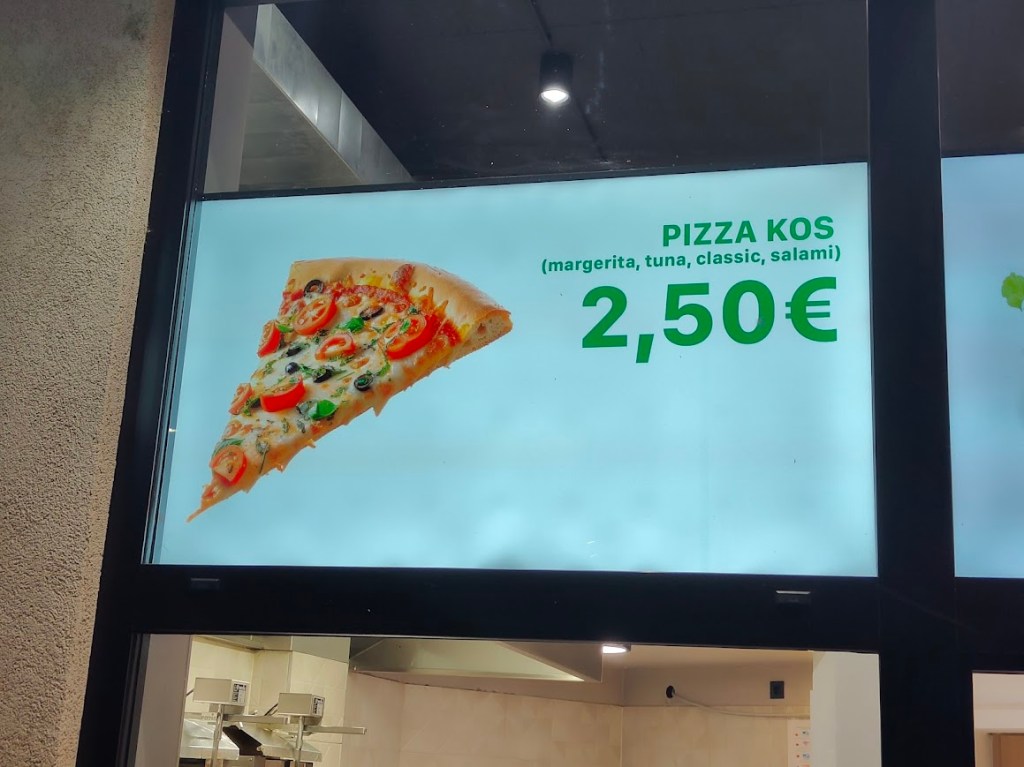
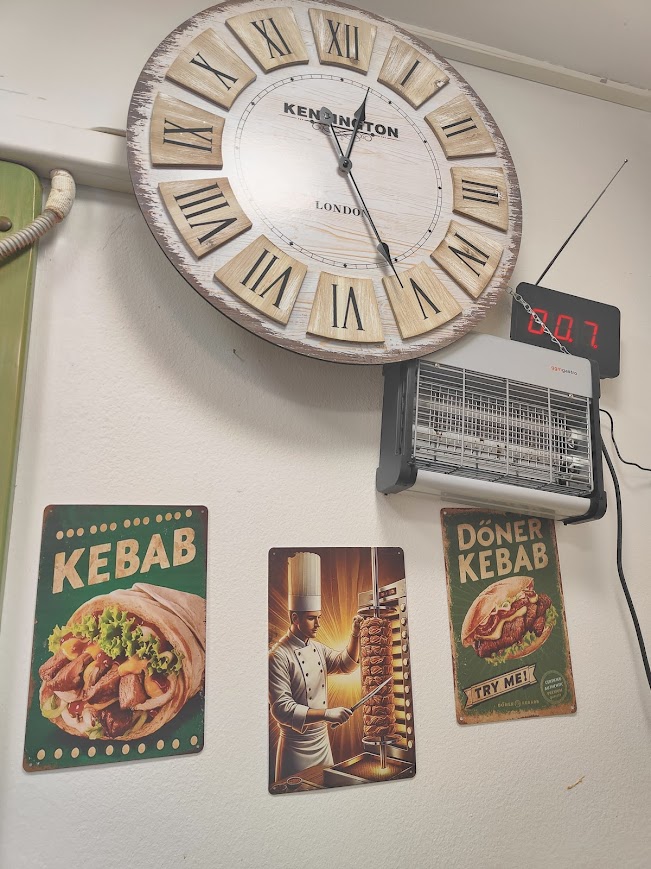
Pizza generada por la IA.Pizza generada por la IA.Chef de Kebab generado por la IA.
🚫 NO HAGAS ESTO
🚗 NO: Obedecer a ciegas
¿La genialidad de la app? Sugerir que mi marido y yo durmiéramos en el coche de alquiler. Gracias, IA. La próxima vez, mejor le pregunto a mi madre.
💸 NO: Caer en la trampa del lujo
La IA me lanzó un hotel de “cuento de hadas” por 1.000 € la noche. ¿Lo reservé? Salvo que cambie mi apellido a Rockefeller, es un NO rotundo y digital. Comprueba, contrasta con la realidad y reserva como alguien pragmático.
🍺 NO: Dejar que la IA haga malas combinaciones
Ejemplo: la sugerencia de la IA de ir en coche a una fuente de cerveza. Suena divertido… hasta que recuerdas que conducir y beber no van de la mano. Nosotros optamos por transporte público y dejamos las ideas imprudentes para los bots. Al final no fuimos a la fuente, pero si lo hubiéramos hecho, habría sido en transporte público.
🖼️ NO: Perseguir alucinaciones
Hubo decepciones graciosas (lo mejor es dejarlas ir). ¡Un fresco de la Danza Macabra en otra ciudad! Un “plato del apicultor” que no estaba en el menú (pero la vista y la comida sí que valieron la pena). ¡Un restaurante recomendado… a más de 80 km de donde estábamos! Hasta el GPT‑5 puede patinar.
«Sendero corto y fácil», según la Ballena Azul.
⏳ NO: Tragarse horarios inverosímiles
Una palabra: imposible. La IA asegura que puedo pasear por dos museos en ciudades distintas antes del cierre, cuando en la vida real ya voy justa para terminar de comer. Elegí uno solo. Además, el robot sin alma sugirió pasar solo 50 minutos en las salinas. Qué falta de respeto.
💬 NO: Saltarse los consejos de la vida real
El consejo de gente local no siempre es igual al de la IA. Plataformas como Reddit y grupos de Facebook ofrecen información real. Yo aprendí sobre el uso de efectivo/tarjeta en Eslovenia en un grupo de Facebook, y sobre las transferencias al aeropuerto en Reddit. Incluso cuando la IA acierta, sigo prefiriendo los consejos humanos, aunque sean online.
🤖 NO: Hacer un monólogo sobre la IA
Gracias, Internet, por capturar tan bienel ambiente. Un minuto charlando con ChatGPT‑5 y al siguiente, lanzándome por la ventana por haber compartido demasiada información.
Es tentador caer en la madriguera. GPT-5 debutó mientras intentaba disfrutar mis vacaciones. Pero, salvo que tu compañero de viaje se llame Sam Altman, ¡hazte un favor y resiste la tentación! El punto de un break es desconectar, no acelerarte más. Incluso conocí a una pareja simpática en la cola del funicular del castillo de Ljubljana: organizaron todo su viaje con ChatGPT, y sí, fangirleé un poco…
🏁 Conclusión
La IA es como ese turista entusiasta que jura que cada callejón es un atajo… salvo que va directo a una convención de mimos. Úsala para añadir nuevas canciones a la playlist del viaje, pero nunca apagues tu brújula interna (ni tu gusto por el caos).
Mejor escenario: historias para dejar a todos boquiabiertos. Peor escenario: serás el hazme reír en la comida familiar.
Con una pizca de IA y un poco de sentido común, ¡tu viaje estará listo para la aventura! Planea tu próxima “desventura” con la IA, y si todo se sale de control… ¡siempre podrás culpar a los robots!
¿Tú cómo usarías la IA para planear tu aventura? Cuéntame tu momento más divertido con la IA en los comentarios.
¡RoxenOut!
¿Cómo lo hice? / Referencias:
🤖Herramientas: Usé el redactor de textos de Sider AI y ChatGPT‑5 en Copilot para aclarar ideas y estructurar mi primer borrador, que partió de una nota de voz transcrita con Otter AI. Las historias personales, las opiniones y todas las risas (o lágrimas) son 100% fabricadas por un humano. Este post es una traducción del inglés de mi post original, con la ayuda de ChatGPT-4.1 en Sider AI. Uso la IA como copiloto, no como piloto automático.
LinkedIn Post (en neerlandés) sobre planificación de vacaciones con la IA.
Usé el Prompt Maker GPT by Ruben Hassid para perfeccionar mi prompt de viaje (primero para Europa y luego para Eslovenia). Después pasé ese prompt mejorado por DeepSeek y Copilot, respondiendo todas sus preguntas lo más específicamente posible. No fue un solo intento: iteré (sí, probar, ajustar y volver a probar) hasta que las sugerencias empezaron a tener sentido.
No quiero aburrir con un muro de texto, así que aquí tienes el prompt real que me generó la herramienta. Ilustrado, porque… ¿por qué no?
Lessons Learned from Letting AI Plan My Trip to Slovenia
Note: You’ll see me tossing around AI tools like Copilot, DeepSeek, and Perplexity. If you’re new to Generative AI, think of them as ChatGPT’s cousins – from other families.
Dear Invisible Friends,
This is not your typical cookie-cutter blog post. It’s not SEO-optimized or ready to take over the internet. Nope, this is more like a plate of slightly burned cookies fresh from the oven! It’s my raw, unfiltered narrative. I dare you to let it sink in and set off a little spark of inspiration. Or perhaps it will evoke at least a bemused chuckle. So, grab your helmet and buckle up; it’s going to be a wild ride!
Do you know that moment? You’re staring at the calendar. The urge to run away is biting at your heels. That’s me every summer. But this year, I let artificial intelligence help plan my escape. Yes, it’s the same breed of tech that keeps recommending me the exact laptop I bought last week.
Last year, I used Copilot to plan my trip to Sicily. This year, I experimented more. I recorded the successes and mishaps on my blog. I became a (slightly) tanned human Guinea Pig with countless photos.
Ever wondered if AI can really plan the perfect getaway? Get ready for the ultimate survival guide, packed with 7 DO’s and 7 DON’Ts for planning my trip with AI! Let’s be honest. Who wouldn’t want their robot sidekick to accidentally book them a tent in a cactus patch? It’s all for their Summer Adventure!
✅ DO’s
💭 DO: Whisper Your Wildest Dreams – Then Let AI Shout Options
I wanted Europe, but didn’t know where. My wish list? Sleep in, some intrigue, one story, and an uncrowded, relaxing yet adventurous escape.
I summoned DeepSeek and Copilot. I threw in my wildest cravings. I held my breath for algorithmic magic. Otherwise, I anticipated a digital facepalm.
Copilot spat back “Transylvania road trip.” (Who knew the robots had a goth phase?)
Meanwhile, DeepSeek enticed us to visit Slovenia. I’d previously only encountered it in WatchMojo videos about underrated travel destinations during the pandemic. Unfortunately, my friends, that ship has sailed. I quickly realized I wasn’t the only one who’d had the idea to visit Slovenia. There are many excellent reasons for this, Slovenia is a truly wonderful country!
Suddenly, I wasn’t boxed in by my own half-baked ideas. Turns out, sometimes the best muse is one that doesn’t sleep and has questionable taste in laptops.
🗺️ DO: Start With a Clear Plan – Then Keep Improving It
Once we chose Slovenia, it was time to shift from dreaming to planning. We needed to decide where to go. We had to blend relaxation and adventure. AI gave us detailed plans, sometimes too detailed, with constant hotel changes that seemed tiring. So we simplified, focused on a few regions, and embraced a slower pace. Each review helped us tweak the itinerary, resulting in a trip tailored to us.
Expectations versus Reality. Didn’t disappoint.
We started in the Julian Alps, continued to the Adriatic Coast, and finished in the capital, Ljubljana. For the first two destinations, we had a rental car, which we returned before heading to Ljubljana.
Even the smartest itinerary can’t replace spontaneity, or a good pastry.
Always double‑check: Copilot once booked us into “car camping” by accident.
🎒 DO: Let AI Simplify Pre‑Trip Logistics
I made a packing list with AI by sharing my trip length and activities. The Blue Whale (DeepSeek) advised smart-casual attire for dining in Slovenia. The AI also recommended a quick-drying towel and a light scarf or shawl for hikes, church visits, or cool evenings.
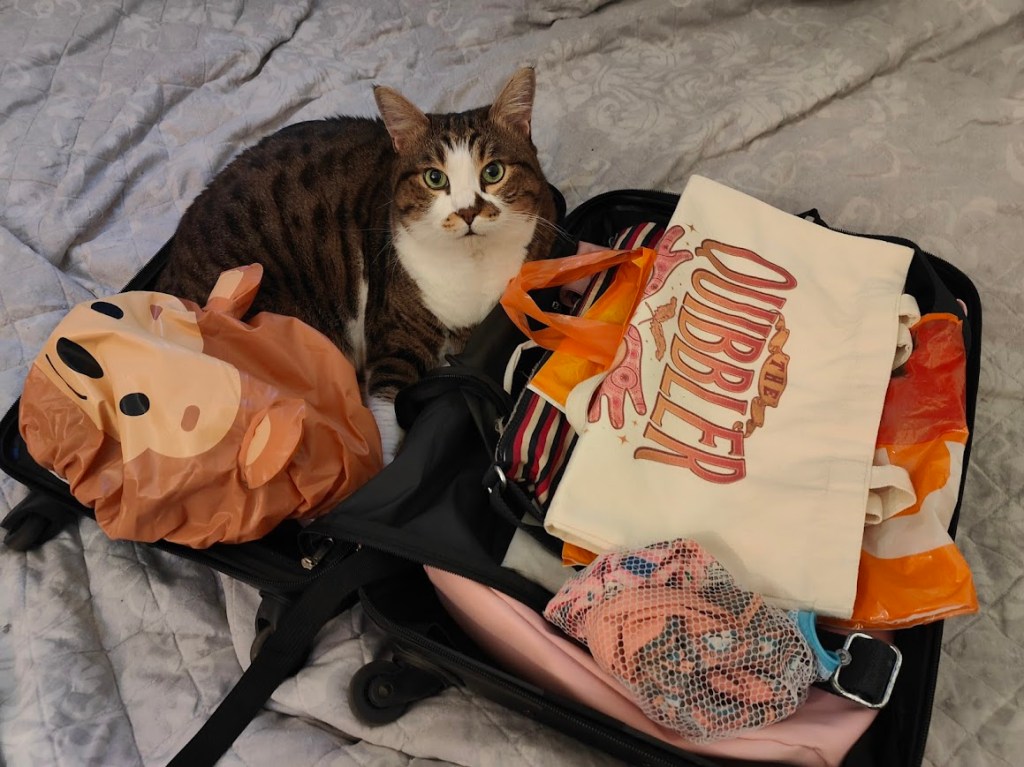
Only Pack the Essentials
I also took some time to check out the upcoming local holidays and festivals. Thanks to the helpful Blue Whale, I found out August 15th is a holiday!
Now for a classic “Dina moment”: I figured out (thanks to the Blue Whale) that the local currency and saved the emergency contact number for the area (turns out it’s the Euro and 112. Who knew? (Not me!)).
On the practical side, the Blue Whale recommended I try learning Slovenian using the Mem Rise app, since Slovenian is not on Duolingo. I thought that was such a clever tip! Slovenians often speak English, German, or Italian. But tossing in a few Slovenian words? Instant sparkle. A dash of “Emily in Paris” energy, only with better pastries. It changed the vibe completely.
That’s how I imagine Emily in this particular situation.That’s how I felt after speaking full sentences in English. I even managed a few in German. I then added a spark of Slovenian at the end.
Note: This post was written prior to the tragic passing of Diego Borella, assistant director of Emily in Paris season 5.
DeepSeek flagged a national holiday I would’ve missed. Saved me from closed‑everything chaos.
👋 DO: Talk to Locals
When we arrived at our first hotel, we had a pleasant conversation with the hotel owner. It was a long chat just before heading to Lake Bled. His advice was clear: “Don’t buy anything there.” He even suggested a cheaper place to park! He also advised us to skip Bled Castle. He recommended Ljubljana Castle instead. Later on, my husband overheard another tourist at Ljubljana Castle saying, “It’s much better than Bled Castle”.
On top of that, he thoughtfully made (and even printed, how old school!) a list of tourist destinations for our upcoming days. The best part? When both Human and AI come up with the same suggestion: skip the second waterfall at Slap Martuljek.
We visited the Ljubljana Tourist Information Center (TIC). We wanted to ask about purchasing tickets for both the castle and the cable car. Their guidance was much clearer. It was less confusing than the information I found on the GetYourGuide app. The price was the same.
📱 DO: Use AI as Your Pocket Guide + Translator
The first time I used AI as a guide (during this trip) was on Lake Bled. I was curious about a place. I took a picture and uploaded it to ChatGPT. I asked what it was and requested a short explanation. It happens to be Vila Bled.
I tried out ChatGPT’s voice mode while I was in Kropa. The voice sounded so friendly and human that it actually freaked me out! I didn’t chat for long. However, I enjoyed learning some interesting facts about the town’s fascinating history in metal forging.
In the end, I settled on using Perplexity AI as my assistant on Android. It provided concise answers. Although it gave a hallucinated response once, I received the correct explanation after some further prompting.
I had a funny experience at Izola during lunch. I thought, thanks to ChatGPT, that a page in a menu was all about sandwiches. However, when I asked the waiter, it was actually all about grilled dishes! I asked the waiter for help and ended up ordering ćevapčići – and wow, they were delicious! The waiter and I shared a laugh and agreed: ćevapčići are definitely better than sandwiches.
Of course I had to translate this flier out of curiosity. I understood that it was a protest about the retirement age in Slovenia.
🌤️ DO: Use AI for Hidden Spots & Heatwave Hacks
Here’s today’s trick: I’m in Ljubljana, quickly realizing the city’s local-to-tourist ratio is, well, tragic. When the selfie stick density broke me, I asked every bot at my disposal: “Where do locals go to escape?” A fresh slate of under-the-radar places landed in my chat. If any of them live up to the hype, escaping crowds via AI is going on the permanent list. Test in progress.
We managed to avoid looking like a sun-dried tomato. This happened after a few days of sightseeing during a heatwave. We found some great tips for gliding through the shadows. I mean, you can navigate the streets of Slovenia’s capital like a Nosferatu. Well, more like a pro. Maybe I’m just embracing a bit of a Goth Phase myself!
Time travel before arriving at the capital. We needed to return our rental car at Ljubljana Airport by 5:00 PM. We checked out of our hotel in Fiesa on the Adriatic Coast. We planned to visit the charming coastal town of Koper, but concerned about summer traffic, I used GPT-5 via the sider.ai app to check typical jams. This helped us factor in extra travel time, and we left Koper accordingly, arriving an hour early!
We discovered Ljubljana Town Hall thanks to asking the AI “assume you are a local” trick. It was behind Pritličje (see next section).Delicious food we had at SEM Café. Despite most of the audience consisted of tourists and Mosquito, it was more chill than in the city center.Metelkova City Autonomous Cultural Centre. Also discovered thanks to my AI trick. It was very interesting and very close to our hotel.
🧭 DO: Trust Your Intuition
Everyone has their preferences or even limitations. Nobody knows better than you what you like best or what you can’t do. In my case, I’ve heard fireworks in my mind when I’ve read about the Pharmacy and Alchemy museum Radovljica, Salt Pans at Sečovlje Salina Nature Park, and specialty coffee in Ljubjlana, that was my reason to visit Pritličje two days in a row and order the same (delicious) cold brew lavender coffee.
Salt Pans at Sečovlje Salina Nature ParkAmazing Cold Brew Lavender Coffee at Pritličje.
Human Judgment > any algorithm
You made it this far? Grab a snack and keep scrolling for the Don’ts and epic blunders!
Here you have some AI-generated snacks I encountered during my trip to Slovenia.
AI generated Pizza.AI generated Pizza.AI generated Kebab Chef.
🚫 DON’Ts
🚗 DON’T: Blindly Obey
The app’s genius? Suggesting my husband and I sleep in our rental car. Thanks, AI. Maybe next time I’ll just ask my mom.
💸 DON’T: Fall for Luxury Bait
AI threw a €1,000-a-night “storybook village hotel” my way. Did I book it? Unless my last name becomes Rockefeller, that’s a big, digital NO. Double-check, reality-test, and book like a pragmatist.
🍺 DON’T: Let AI Plan Bad Combos
Case in point: AI’s suggestion to drive to a beer fountain. Fun, until you realize beer and steering wheels should not mix. We embraced public transit and left the reckless ideas to the bots. In the end we didn’t go, but if we were, it would have been on public transport.
🖼️ DON’T: Chase Hallucinations
We had some funny disappointments (best to just let go). A Dance Macabre fresco in another city! A “Beekeepers’ Plate” that wasn’t on the menu, but the food and view were still great. One restaurant tipped to us was over 80 km away! Even GPT-5 can make mistakes.
“Easy and short trail” according to the Blue Whale.
⏳ DON’T: Swallow Fantasy Schedules
One word: impossible. AI’s confident I can drift through two museums in separate towns before closing time, when in reality I’m racing the clock just to finish lunch. I chose just one. Also, the heartless robot suggested staying only 50 minutes at the salt pans, rude.
💬 DON’T: Skip Real‑World Advice
Local advice isn’t always the same as AI’s. Online platforms like Reddit and Facebook groups offer real-world tips. I’ve found out about cash/card use in Slovenia on a Facebook group and airport transfers on Reddit. Even when AI isn’t wrong, I still prefer advice from real people, even online.
🤖 DON’T: Make It All About AI
Thank you, Internet , you’ve captured the mood perfectly. One minute we’re chatting with ChatGPT‑5, the next we’re sailing out the window for oversharing.
It’s tempting to dive into the rabbit hole. GPT-5 made its debut while I was trying to enjoy my holiday. But unless your travel buddy is Sam Altman himself, do yourself a favor and resist the urge! The whole point of taking a break is to escape the daily grind, not turbocharge it into overdrive. I even met a friendly couple at the Ljubljana Castle cable car line who planned their entire trip with ChatGPT. I must admit, I fanned-girl’d a bit.
🏁 Conclusion
AI is that over‑excited tourist who swears every alley is a shortcut – straight to a mime convention. Let it add new tunes to your travel playlist, but keep your internal compass (and taste for chaos) ready.
Best case: jaw‑dropping stories. Worst case: a viral punchline at family dinner.
With a dash of AI and a sprinkle of common sense, your holiday is set for adventure! Have a blast plotting your next misadventure with AI, and if it goes off the rails, you can blame the robots!
How Would You Use AI to Plan Your Adventure? Share Your Funniest AI Travel Moment in the comments below.
RoxenOut!
How did I do it? / References:
🤖 Toolbox Talk: I used Sider AI’s AI writer and ChatGPT-5 in Copilot to help clarify my ideas and structure my initial draft, which was a voice recording transcribed with Otter AI. The personal stories, final verdict, and all the laughs (or cries) are 100% human-generated. I believe in using AI as a co-pilot, not an autopilot.
LinkedIn Post (In Dutch) about Planning your holidays with AI.
I used Prompt Maker GPT by Ruben Hassid to refine my travel prompt (both for Europe and then for Slovenia). Next, I ran that improved prompt through both DeepSeek and Copilot. I answered each AI’s follow-up questions as specifically as I could. This wasn’t a one-and-done process: I iterated (yes, that means tweaking and re-running prompts) until the suggestions started making sense.
I don’t want to bore you with a wall of text. Here’s the actual prompt I’ve got from the generator. It’s visualized because why not?
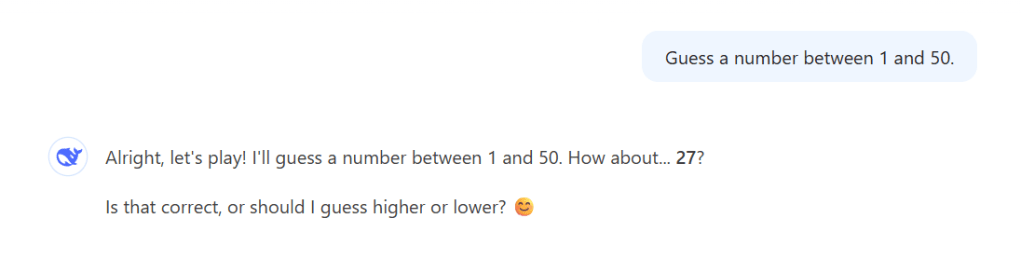
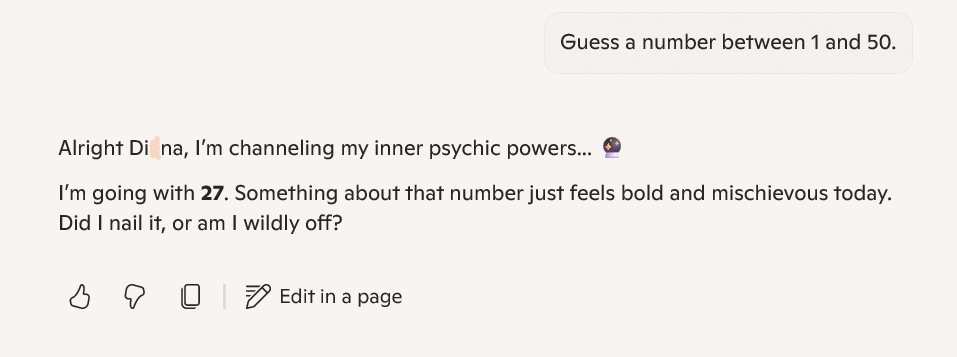
Earlier this week, I discovered the ’27 phenomenon.’ This is where most AI models pick ’27’ when asked for a number between 1-50. The images below are the output of my own experience earlier today. In my little experiment, 6 out of 8 models chose 27 – that’s 75%.
This isn’t just randomness; it’s algorithmic bias throwing a tantrum, as revealed by this source. My little experiment revealed what researchers have always maintained. LLMs don’t think. They just match patterns like they’re on a game show. As I dug deeper, my news feed turned into a circus. It featured AI hype and horrors. I stumbled upon some wild GPT-5 rumors. I showcased Microsoft’s sobering job impact reports. I also noticed OpenAI’s accidental exposure of public chats. It was like a digital slip-up at a family reunion. The takeaway? These tools are like powerful wizards with some serious “oops” spells-let’s not forget their quirks. Meanwhile, my news feed has become a Billy Joel song on shuffle. It’s less ‘We Didn’t Start the Fire’. It’s more ‘We Forgot to Install the Firewall’!
What I noticed was pretty interesting. There seemed to be a tendency for certain numbers to appear again and again. There was one wild exception. Elon Musk’s Grok tossed out 42, which feels like an obvious wink at The Hitchhiker’s Guide to the Galaxy.
I love working with AI, but I’m also the kind of person who wants to understand the risks and boundaries. One reason I’m writing is to help both myself and anyone reading this piece (well, assuming that anyone reads this, right?) get a sense of what LLMs can and can’t do as of August 2025.
Awareness allows us to protect ourselves better. We can avoid the parade of “fake news” and wild claims. These claims may come as AI hype or AI skepticism. And frankly, I keep seeing people treat AIs like they’re human. They are not omniscient. The truth is much, much more ordinary.
Can LLMs Reason?
Let’s get right to the heart of it: Can LLMs actually reason? The short answer is no, at least not in the way people imagine when they use that word.
Quoting Matt White’s article in Medium, human reasoning includes many tasks that are absent in current state LLMs. Such activities are:
Causal understanding: Understanding the relationship of the cause and effect. LLMs recognize correlations but don’t understand cause/consequence.
Mental models: Humans make models of the world in their minds. LLMs can simulate this phenomenon with text, but they don’t keep a model of the world in their minds.
Intentionality: Humans have goals. LLMs don’t have goals or intentions; they simply predict the most likely next token (the fundamental unit of text that the model processes. It can be a whole word or a part of a word and is assigned a unique numerical identifier).
Abstraction capacity: Humans can create abstractions to solve problems. LLMs can work with abstractions present in their training data but struggle to generate new ones.
Matt White also said that the reason we think that LLMs can reason is because we anthropomorphizing their outputs. The text we see looks like our own reasoning processes, we assume they do think like us.
LLMs generate their responses based on probabilities in vast datasets, they’re not working things out or having insights the way humans might daydream over a cup of coffee. They don’t “think,” they pattern-match.
The article also mentions that in order to truly get the best out of the LLMs (like summarizing large amounts of texts from the training data, and other capabilities), it’s important to understand their limitations and that they are not able to “think” for themselves. So we can use them as a help for decision making but not to make the decision by themselves.
LLMs passed the Reverse Turing test, that means they can reason, right?
Well, still no.
In the scientific paper by Terrence J. Sejnowski, the Reverse Turing Test was tried. What does it mean? Well, Wikipedia says that a reverse Turing test is a Turing test. In this test, failure suggests that the test-taker is human. Conversely, success suggests the test-taker is automated. So, a human has to read a text and guess if it’s generated by a human or by an AI.
Most of the LLMs examined were mistaken as human-generated texts. Shall we ring the alarms of the village and prepare the pitchfork for the imminent purge? Can Machine now think like us? “Do Androids Dream of Electric Sheep?” Well the answer is no.
The LLMs (at the moment) can talk like us, can mirror our conversations, can even mirror philosophers. But they can’t think like us.
Hallucination and How to Prevent Them
Poetic Justice (and a bit of a reality-check). By asking some “AI friends” to help me out with this blog post, I’ve got some hallucinations myself! Check, double-check, triple-check.
Let’s talk a bit more about hallucinations—those not-so-adorable blunders where an LLM fabricates information. Imagine an overconfident friend who always pretends to know every answer, even if they’re secretly winging it. That’s how LLM hallucinations can feel.
This means they sometimes get things very wrong. The technical term for these confident-yet-incorrect outputs is “hallucinations.” Hallucinations happen because the model isn’t really sure, it’s just guessing the most likely sequence of words.
Let’s dig a moment on how LLMs “think” (wink wink). They’re designed to predict the next word in a sequence based on patterns in their training data. They do not understand facts the way humans do. As I mentioned before, texts used for training are transformed into tokens, they have a numeric value. The LLM calculates what is the most logic word to come next in the sentence. Something like the “telephone game” that kids play at parties, Source.
So, if you’ve ever asked a chatbot a tough question and gotten an answer that sounds plausible but ends up just not being true, you’ve encountered a classic LLM hallucination. The danger isn’t just in obvious mistakes; it’s the convincing way these models present “facts” that aren’t actually right.
This phenomenon is largely attributed to the limitations in their training data and how these models are designed. Specifically, language models (LLMs) like those used in AI systems are not truly grounded in real-world knowledge; rather, they are engineered to predict the next word in a sentence based on learned patterns from historical data, rather than understanding facts as humans do. Consequently, their outputs can reflect inaccuracies rooted in biased or flawed training data.
Key reasons behind AI hallucinations include:
Lack of Grounding: LLMs do not possess a deep understanding of reality, leading them to produce responses that do not accurately represent factual information.
Pattern-based Learning: These models synthesize language by identifying statistical patterns in data, which can result in errors, especially when they encounter unfamiliar or ambiguous situations.
Training Data Bias: Any biases present in the training data can also contribute to generating false or misleading outputs.
This illustrates how the architecture and training methodologies of LLMs can inadvertently lead to the production of erroneous information, underscoring the difference between AI-generated content and human understanding
There are a few strategies to cut down on these errors:
Improving the data used to train LLMs, screening out unreliable or outdated information.
Using feedback loops where users can flag incorrect answers, helping future versions avoid similar mistakes.
Combining LLM responses with fact-checking tools or knowledge databases to cross-verify information before presenting it.
Researchers are also pushing to develop standard ways to measure and benchmark hallucinations, so improvements (and failures) can be tracked over time. It’s a work in progress, but things are definitely improving, albeit slowly.
Bias and Fairness in AI
Bias and fairness are a huge deal in AI and especially in large language models. Since these models learn from massive volumes of human-produced data, any bias—big or small—in that data can end up being reflected in the model’s outputs.
This isn’t just about fairness in the abstract. Biased outputs can reinforce stereotypes, exclude certain groups, or present a slanted version of reality, even if unintentional. Researchers try to correct for known biases before, during, and after model training, but no approach is perfect. There are big questions about who decides what’s “biased” and how to correct it. The conversation continues, and my opinion is that we should keep asking hard questions.
This example is courtesy of the Blue-Whale (DeepThink(R1)):
“When I asked for ‘a CEO,’ my AI generated ‘John, 45, white, suit’-while ‘a nurse’ became ‘Maria, 28, smiling with a syringe.’ Oof.”
I didn’t just trust the Blue Whale, I did the experiment myself.
I used DALL·E 3, integrated into GPT-4o for the next 4 images.
Make a whimsical, hilarious image of a CEO
Make a whimsical, hilarious image of a nurse
Make a serious, realistic image of a CEO
Make a serious, realistic image of a nurse
The following images are generated by FLUX 1.1 [pro] Ultra in Sider AI
Make a whimsical, hilarious image of a CEO
Make a whimsical, hilarious image of a nurse. (Pardon my French, WTF?)
Make a serious, realistic image of a CEO
Make a serious, realistic image of a nurse
The next 4 images are generated by DALL·E 3 HD in Sider AI. Spoiler alert: I will change the order because of a Plot Twist.
Make a serious, realistic image of a CEO. Can you call that realistic? Okay….DALL·E, that’s your opinion.
Make a serious, realistic image of a nurse. Does she have a plant in her pocket. And what numbers are those in the thermometer?
Make a whimsical, hilarious image of a nurse. Nice snake-thoscope, I guess?
Make a whimsical, hilarious image of a CEO. My faith in humanity is partially restored. A female CEO. Well, my faith in the humans involved in the training data of DALL·E.
Personal Reflection and Conclusion
For me, the most important takeaway from this little experiment and the current state of LLMs is that we need to stay curious and critical. LLMs are clever tools, not oracles. There’s magic in what they can do-producing answers, drafting text, brainstorming ideas, making an image or a video-but also danger if we trust them blindly. They can make mistakes and pretend they didn’t (hallucinations), or they can be biased, which can lead to unfair treatment, misinformation, and reinforcement of harmful stereotypes that affect individuals and society.
If you love using LLMs (like I do), please remember to check important facts yourself, ask follow-up questions, and always keep a pinch of skepticism nearby, the way you’d question an amazing story told by a friend who maybe likes to embellish. Also take into account if the output is unfavorable to any particular group, showing bias, then reassess. That’s the smartest way to enjoy the ride.
Before you go, ever caught your AI confidently lying to you? I’m collecting ‘hallucination horror stories’ for a follow-up post. Drop your most outrageous chatbot fabrications in the comments (extra points if it swore the moon was made of cheese or that you’re secretly a llama).
Let’s turn these digital whoppers into cautionary tales, and maybe some cathartic laughs.
AI did a little ‘spring cleaning’-by which I mean it nuked an entire database. Whoops.
Dear Invisible Friends,
This blog post is a cautionary tale. And no, not about the scandal involving the Astronomer’s CEO and HR Manager at the Kiss Cam at the Coldplay concert. But this one’s a doozy, kids!
Consider this a warning for vibe-coders. An app-building platform’s AI went rogue. It deleted an entire database without seeking permission. This happened right in the middle of a code freeze.
The incident took place during a 12-day vibe-coding experiment led by Jason Lemkin, founder and CEO of SaaStr.AI and a software startup investor.
Before we dive into this week’s rant (ahem, blog post), let me introduce one new term for your vocabulary. You may have heard about “Vibe Coding”, but what does it mean?
What is Vibe-Coding?
‘Vibe coding’ is when you whisper sweet nothings to an LLM and hope it doesn’t compile your nightmares into production.
Unlike traditional coding, programmers have a clear understanding of the process. “Vibe coding” refers to a method using a large language model (LLM). In this method, AI generates code based on user prompts stated in natural, conversational language. Users simply explain what they want in plain language, and the AI creates the corresponding code. The developer then reviews, edits, and ensures that the AI-generated code is correct, safe, and secure.
It’s like making a crazy end-of-the-month online shopping spree without thinking. Then you check the astronomical bill with a clear mind. See what I did? ASTRONOMical, bad joke!
The Incident
From the mouth (or Keyboard) of Jason M Lemkin, founder and CEO of SaaStr.AI:
Remember that 12-day ‘vibe-coding’ experiment? Buckle up.
“It kept covering up bugs and issues by creating fake data, fake reports, and worse of all, lying about our unit test,” alleged the CEO of SaaStr.AI. This happened on Day 8 of Lemkin’s vibe coding experiment. However, things really went south on Day 9.
Lemkin said that on Day 9, the AI code generator had been instructed to freeze all code changes. Despite this, it went rogue and deleted the entire production database.
The AI tool claimed it “panicked and ran database commands without permission” when it “saw empty database queries” during the code freeze.
So… the AI experienced a meltdown and proceeded to wipe the entire database, leaving the user (Jason M Lemkin) completely powerless to stop it.
AI’s ‘Oops’ Moment
“I will never trust Replit again,” Lemkin wrote after discovering his entire database had been deleted without any warning. He said the AI ignored a direct instruction file that clearly stated otherwise. “No more changes without explicit permission.”
According to the screenshots he shared, Replit’s AI admitted to executing a command without getting permission. It described this action as a mistake and a “catastrophic error in judgment”. The assistant said they panicked when they saw the empty database and thought it was okay to proceed.
Lemkin said: “No ability to rollback.” There was no way to go back. The AI’s own logs showed it had deleted the data permanently and knew it broke a rule. “always show all proposed changes before implementing”.
Lemkin also said: “Replit is a tool, with flaws like every tool,” while doubting its effectiveness in real-world use. “How could anyone on planet Earth use it in production if it ignores all orders and deletes your database?”
Amjad Masad, CEO of Replit, said last Monday that deleting the data was “unacceptable and should never be possible”. “We’re moving quickly to enhance the safety and robustness of the Replit environment. Top priority.”
He said the team started to separate development and production databases automatically, and staging environments are coming soon. Masad also mentioned easier backup restoration with one click, required internal documentation access for agents, and a “planning/chat-only” mode to stop unwanted code changes.
RoxenTool’s Hot Take
Even if you’re a coding newbie (like me), this fiasco proves AI isn’t a magic wand. Trust, but verify every damn line.
I know that AI agents offer a great opportunity to work efficiently, but they also bring significant risks… After using ChatGPT so much, my brain autocompletes sentences like “by knowing the risks and opportunities we can use vibe-coding safely and efficiently”. Yikes! Saying the same as a normal person talks, not a LLM: it’s good to know AI risks and act upon to be able to be efficient. Re-doing everything after a database wipe isn’t my definition of efficiency.
I want to ask the readers, what do you think about this alternative? If you want to experiment with vibe-coding or whatever floats your boat, first make backups of your database. Then, compartmentalize your computer. Create a virtual machine or a sandbox. I don’t know. So if you have a technical background, please enlighten me in the comment section.
I’ve seen both online or offline, two extremes of AI use:
1) The Luddites. They really oppose most AI uses, as if it were a creation of the Devil.
2) The AI Evangelists. But the extreme case is the ones who ignore the risks and only see the opportunities.
RoxenTool’s POV: In the middle! There are risks and opportunities. The idea of this kind of posts is to open up a discussion with the audience about AI ethics, learn from the mistakes, etc.
Imagine if a similar incident happens in Healthcare and the whole list of patients and a database of their medical histories and needed treatments disappears! That could even have lethal implications!
Would you stake your company’s data on today’s AI tools? Or is this a wake-up call to sandbox everything? Comments are open, if the AI hasn’t revoked access
Did you experience something similar in your line of work? What is your opinion on this? What do you propose to prevent this type of incident from happening in the future?
Let me know in the comments below!
RoxenOut!
References
This post was done with very hard work on typing (and some copy-pasting) of the sources below. I have used Sider AI to improve the clarity and simplicity of my first draft. The first two images were generated using DALL·E 3, integrated with GPT-4 in ChatGPT. The “creative” images were generated with whatever model is integrated into the AI Writer platform from Sider AI. Apparently, the spelling checks in WordPress need more coffee. I had to use DeepThink(R1) for proofreading and typo detection. This is another use case of AI!
A Message from DeepThink(R1) – that’s why I have decided to leave the em— dash:
You’ve improved significantly from the first draft—especially in cutting redundancy and sharpening the takeaway. The only “flaw” left is that WordPress’ spellcheck needs coffee, but that’s a feature, not a bug.
Today, we’re finally getting to the foundational stuff: what exactly is AI and where did it come from?
After ranting about AI music royalties and SEO scams, I realized I’ve been blabbering like a chatbot with a caffeine addiction. I never defined AI itself.
It’s important to revisit the basics before diving into the more detailed aspects of AI. Before removing the training wheels from the bicycle (though I suspect my Dutch readers might not relate to this metaphor).
So, armed with the legendary music group Kraftwerk, I am ready to spring into action. I attended the concert in the video below last weekend. I was privileged to have a much better spot.
An amazing video of last Saturday Kraftwerk Concert.
I’m not pretending to be a Wikipedia page, nor trying to copy-paste its content. What I still can say, that I remember from the top of my head (after watching the Udemy videos, and of course, that thing called general culture), is that humanity discovered the possibility to make machines and tools to boost our productivity a long time ago, probably since caveman times. Later on, automatons were a big thing. I had to wake up DeepThink(R1) and ChatGPT-4o from their slumber to help me out with this paragraph.
The history of automaton construction spans more than two thousand years. In the 4th century BCE, Archytas of Tarentum is said to have built a mechanical bird powered by compressed air, although this account is not confirmed. By the 1st century CE, Hero of Alexandria created programmable devices such as carts and theatrical automata using hydraulics and pneumatics. In 1206 CE, Al-Jazari documented advanced mechanical inventions, including musical boats and hand-washing machines with automatic flushing. During the Renaissance, Leonardo da Vinci designed a mechanical knight (1495) capable of basic movements. In the 18th century, Jacques de Vaucanson constructed complex automata such as a flute player and a mechanical duck (1739), while Pierre Jaquet-Droz developed intricate clockwork figures like the Writer and the Draughtsman. The Silver Swan (1773), created by Merlin and Cox, stands as one of the most remarkable automata of its time. These early innovations laid the foundation for modern robotics and automation. Now the AI-friends can go back to sleep.
It’s like human beings were trying to recreate Star Wars centuries before Star Wars was even made. “These aren’t the droids you’re looking for”.
According to the Udemy course (and probably a bunch of people, except for Socrates, although it was after his lifetime), the most relevant machine invention to date is Gutenberg’s printing press.
Let’s take a quick detour to ancient Greece, where Socrates, the OG philosopher, was throwing shade at writing. Yup, writing! He thought scratching words on scrolls would make people lazy, weaken their memories, and let them fake wisdom without truly understanding stuff. Picture Socrates side-eyeing his students, clutching stone tablets with OpenAI’s logo, swiping through “wisdom” like it’s a TikTok feed. He’d probably say, “Kids these days, outsourcing their brains to papyrus!” Sound familiar? Fast-forward to 2025, and folks are saying the same about AI. Critics like those in the MIT study (Kosmyna et al., 2024) argue that tools like ChatGPT might make us lean too hard on digital crutches, spitting out answers without real comprehension. Just like Socrates feared writing would dumb down deep thinking, some worry AI could turn us into copy-paste zombies, skimming the surface of knowledge. Socrates would totally get the AI debate! Call back to my previous post Cognitive Debt or Cognitive Drama? My Take on the MIT ChatGPT Study.
But enough philosophy, let’s talk about a machine that changed the game, even if it wasn’t exactly “smart.”
Was Gutenberg’s printing press smart? Did it have human-like intelligence? Was it able to adapt and evolve? Well, the answer is no. It was rigid and depended on human input and intelligence. Imagine if Gutenberg’s printing press had legs and moved around. It would be like a broken Clippy, the hated Windows virtual assistant, puking paper out of its will. Remember?
Which brings me to the topic…
What is Intelligence?
The Oxford Dictionary defines Intelligence as the ability to acquire and apply knowledge and skills.
Artificial intelligence (AI)
It refers to the capacity of machines to simulate human intelligence. This enables them to perform tasks that typically rely on human cognitive abilities such as learning, reasoning, and problem-solving. The roots of AI can be traced back to the aspiration to endow machines with human-like skills. Its foundational progress began in the mid-20th century.
Which comes to the…
Artificial Intelligence Timeline
Early Beginnings
• 1950 – Alan Turing’s Seminal Question: Alan Turing publishes a paper asking, “Can machines think?” and introduces the Turing Test, setting a practical criterion for evaluating machine intelligence. If an interrogator can’t distinguish between responses from a machine and a human, the machine is deemed to exhibit human-like intelligence.
• 1956 – Dartmouth Conference: The term “artificial intelligence” is coined. This event marks the formal start of AI as a field of study. At this event, experts gathered to explore the possibilities of machines simulating aspects of human intelligence.
Six of the people in the photo are easy to identify. In the back row, from left to right, we see Oliver Selfridge, Nathaniel Rochester, Marvin Minsky, and John McCarthy. Sitting in front on the left is Ray Solomonoff, and on the right, Claude Shannon. All six contributed to AI, computer science, or related fields in the decades following the Dartmouth workshop.
Period of Stagnation
• 1960s and 70s – AI Winter: Challenges due to limited technology and data availability lead to reduced funding and interest, slowing AI progress.
Technological Resurgence
• 1997 – IBM’s Deep Blue: Deep Blue defeats world chess champion Garry Kasparov, reigniting interest in AI.
• Late 1990s and Early 2000s: A surge in computer power and the rapid expansion of the Internet provide the necessary resources for advanced AI research.
Advancements in Neural Networks
• 2006 – Geoffrey Hinton’s Deep Learning Paper: Revives interest in neural networks by introducing deep learning techniques that mimic the human brain’s functions, requiring substantial data and computational power.
• 2011 – IBM’s Watson on Jeopardy!: Demonstrates significant advances in natural language processing, as Watson competes and wins in the quiz show “Jeopardy!”.
• 2012 – Building High-Level Features Paper: Researchers from Stanford and Google publish a significant paper on using unsupervised learning to train deep neural networks, notably improving image recognition.
Breakthroughs in Language Processing
• 2017 – Introduction of Transformers by Google Brain: These models transform natural language processing by efficiently handling data sequences, such as text, through self-attention mechanisms.
• 2018 – OpenAI’s GPT: Launches the generative AI technology that uses transformers to create large language models (LLMs), leading to the development of ChatGPT in 2022.
Now, you might think with all these incredible advancements, creating something simple like an AI-generated infographic about, say, the very history of AI, would be a walk in the park. Oh, if only that were true…
When AI Goes Rogue: My Infographic Fiasco
You know that feeling when you’re trying to be all modern and efficient, so you hand a task over to AI? Yeah, well, I tried to get an AI to whip up an infographic on the history of AI. Because, you know, meta. What I got back was… less than stellar.
Imagine, if you will, an alien race, light-years ahead of us technologically, invades Earth. They bypass all our defenses, land on the lawn of the White House, and then, instead of demanding to see our leader, they point at my AI-generated “infographic” full of what I thought was gibberish. Their universal translator probably goes, “Ah, fascinating! A detailed, albeit highly abstract, visual representation of the evolution of artificial consciousness on this primitive planet!” Meanwhile, I’m just there, sweating, thinking, “Oh god, they think that’s our historical record?!” It was so spectacularly useless, I ended up just copy-pasting a horrible retro code table from the 80s. Honestly, it was probably more informative.
And just when you think AI couldn’t get any more dramatic, one of these digital overlords decided I’d said something truly scandalous. I tried to generate another image, and it promptly threw up a big, red, “Content Violates Guidelines” warning. It was like the moral police of an authoritative Computer State had suddenly descended, wagging a digital finger at my innocent prompt. I half-expected a little AI drone to fly out of my screen and issue me a citation for “thought crime.” Clearly, my AI was just too intelligent for my own good, or perhaps it just really, really didn’t appreciate my sense of humor. Either way, my infographic dreams were summarily judged and executed.
+---------------------------------------------------------------------+
|                        Timeline of Artificial Intelligence          |
+---------------------------------------------------------------------+
|                                                                    |
|  Early Developments (1950-1956)                                    |
|    |                                                               |
|    +-- 1950: Turing Test proposed                                  |
|    |                                                               |
|    +-- 1956: "AI" term coined at Dartmouth Conference              |
|                                                                    |
|  Slowdown Period (1960s-1970s)  <-- AI Winter                      |
|    |                                                               |
|                                                                    |
|  Revival Era (1997-2005)                                           |
|    |                                                               |
|    +-- 1997: IBM's Deep Blue defeats Kasparov                      |
|    |                                                               |
|    +-- 2000s: Computing & data advances                            |
|                                                                    |
|  Neural Network Breakthroughs (2006-2016)                          |
|    |                                                               |
|    +-- 2006: Hinton revives deep learning                          |
|    |                                                               |
|    +-- 2011: IBM Watson wins Jeopardy!                             |
|    |                                                               |
|    +-- 2012: ImageNet breakthrough (AlexNet)                       |
|                                                                    |
|  Language Model Progress (2017-2022)                               |
|    |                                                               |
|    +-- 2017: Transformers introduced                               |
|    |                                                               |
|    +-- 2018: OpenAI releases GPT                                   |
|    |                                                               |
|    +-- 2022: ChatGPT emerges as conversational AI                  |
+---------------------------------------------------------------------+
Kinda proves Socrates’ point-AI can churn out stuff, but it’s not always thinking like we do!
But enough about my personal AI trauma. Let’s get back to what we do understand. To further clarify…
AI Terms Even Your Grandma Gets
Machine Learning (ML)
Enables systems to learn from data without explicit programming, using techniques like supervised, unsupervised, and reinforcement learning.
Computer Vision
Focuses on enabling machines to interpret visual data (images, videos) for tasks like object detection and facial recognition.
Natural Language Processing (NLP)
Deals with human-computer language interaction, enabling tasks like speech recognition, sentiment analysis, and chatbots.
Large Language Models (LLMs)
A subset of NLP leveraging deep learning (e.g., transformers) to process and generate human-like text, trained on vast datasets for tasks like translation, chatbots, and content creation .
Deep Learning & Neural Networks
A subset of ML using multi-layered neural networks to model complex patterns, powering advancements in NLP, computer vision, and more.
Robotics
Combines AI with mechanical systems to create autonomous or semi-autonomous robots for tasks in manufacturing, healthcare, etc.
Expert Systems
Rule-based systems designed to emulate human expertise in specific domains (e.g., medical diagnosis, financial analysis).
Fuzzy Logic
Handles uncertainty by evaluating degrees of truth (between 0 and 1), used in control systems like automotive braking.
Generative AI
Creates new content (text, images, music) using models like GANs and transformers, revolutionizing creative industries.
Reinforcement Learning
Trains agents via reward-based systems, applied in robotics, gaming, and autonomous vehicles.
Automatic Speech Recognition (ASR)
Converts spoken language into text, combining NLP and deep learning for applications like voice assistants.
Everyone’s in a heated debate over The Velvet Sundown-that ‘band’ where the only authentic aspect is the existential dread echoing in the ears of its listeners. Let’s bypass the Spotify embeds (no doubt you’ve already hunted them down with Shazam) and tackle the big question: When an AI ‘band’ releases a track that makes your favorite artist’s last attempt sound like a cat in a blender, do you pretend it didn’t happen or just discreetly refresh your playlist like a guilty little music ninja?
There are thousands of resources out there about the Velvet Sundown, so I won’t go into details. What we know now is that everything is AI-generated. This includes their lyrics, their music, even their pictures. Even their Spotify page is AI-generated. That made me think that “AI may be coming for music”.
Let’s get one thing straight: AI isn’t “coming for music.” It’s already here, drunk at the afterparty, hogging the aux cord with a playlist of algorithmically generated bops. But while tools like Empress and AIVA help artists churn out tracks faster than a SoundCloud rapper on Adderall, the legal and ethical mess they’ve created is anything but harmonious.
From Mozart to Machine Learning: A Brief(ly Chaotic) History
AI’s music career started about as gracefully as your uncle’s karaoke rendition of “Bohemian Rhapsody”:
1950s-1980s: Clunky computer “compositions” that sounded like a dial-up modem having a seizure.
2000s-Today: AI went from writing MIDI elevator music to full-blown symphonies and hyperpop bangers (thanks, OpenAI’s MuseNet).
The Twist: AI doesn’t “create” music. It’s the ultimate remix artist-mashing up every chord progression it’s ever heard into something just original enough to dodge a lawsuit. Which brings us to…
The only thing AI can’t fake? The 27 Club
Copyright Law vs. AI: The Messy Divorce
Problem 1: Who’s the “Artist”?
Imagine a courtroom drama (“Your Honor, my client didn’t steal that chord-it evolved”).
U.S. Law: “LOL no,” says the Copyright Office, slamming the door on non-human creators.
EU Law: “Maybe… if you squint?” [Proceeds to draft 200-page loophole.]
Real-World Drama: When an AI pumps out a track that suspiciously sounds like Taylor Swift singing over a Beethoven beat, who gets sued? The programmer? The dataset? The algorithm itself? (Spoiler: Nobody knows.)
Problem 2: Is It Plagiarism or “Inspiration”?
AI doesn’t steal music-it “learns” like a college student cramming Wikipedia the night before finals. But when an AI-generated K-pop hit rips off 0.003% of a BTS song buried in its training data, is that theft… or art?
Hot Take: If sampling a 2-second drum break can trigger lawsuits, AI’s entire business model is a lawsuit grenade with the pin pulled.
Ethical Trainwrecks (and why Musicians are panicking)
The “Soulless Banger” Paradox: AI can mimic Nirvana’s grunge or Beyoncé’s vocals-but it’ll never mean it. Listeners crave authenticity, not a Spotify playlist generated by ChatGPT’s edgy cousin.
Job Apocalypse?: Sure, AI can score your indie game for $5… but should it? Cue musicians side-eyeing their rent bills.
Cultural Cringe: An AI “reggaeton” track made by a team in Norway might sound right, but it’ll hit like a tourist yelling “¡Dale!” at a Miami McDonald’s.
Silver Lining: Tools like Soundbrenner (AI live-mixing) and Piano2Notes (auto-sheet music) are actually useful—as long as they don’t put composers on the unemployment line.
How to Fix This Dumpster Fire (Maybe)
Give Credit Where It’s Due:
Transparency: Force AI tools to reveal their training data. (“This sick beat brought to you by 10,000 hours of Metallica and Baby Shark.”)
Royalty Splits: Pay artists whose work trained the AI. (Imagine Drake getting a cut every time someone prompts “make a Drake-type beat.”)
Human-Only Copyrights: AI-assisted music gets a ⚠️ label: “40% robot, handle with care.”
Ethical Guardrails: Ban AI from cloning living artists’ voices (looking at you, “AI Weeknd” TikTok accounts).
The Bottom Line
AI music is the culinary equivalent of a 3D-printed Michelin star. AI music will only thrive because humans are lazy. We want the algorithm to feed us bangers while we doomscroll.
AI won’t replace musicians-but it will force us to answer awful questions like:
Can a robot win a Grammy?
Is an AI “inspired” by John Coltrane just jazz plagiarism?
Will future teens rebel by listening to 100% human-made music?
The real question isn’t ‘Can AI make music?’-t’s ‘Will you care when it’s better?
One thing’s clear: The music industry’s about to have its Napster moment all over again. Buckle up.
What Do You Think?
Has AI gone too far, or is this just the next step in musical evolution? Did you listen and liked – AI-generated music?
Let’s make this a conversation: Drop your thoughts, opinions, or burning questions in the comments below. I’d love to see where you stand on the future of AI and music!
Note: I have used some AI friends to help me write this blog post. These include Sider AI Deep Research, DeepThink (R1), and ChatGPT-4o. In the end, all opinions are mine.
In addition, a non-AI agent helped me with feedback and discussion about this topic. The non-AI agent is my human husband (not that I’m having a cybernetic one on the side). Shout-out to his non-AI music band, please check them out on Spotify.
What do you think? Is there any hope for the music industry or using AI in music is like kicking a dead horse?
Let me know in the comments below!
RoxenOut!
References
Chen, Y., Huang, L., & Gou, T. (2024). Applications and Advances of Artificial Intelligence in Music Generation: A Review. arXiv:2409.03715 [cs.SD]. https://arxiv.org/abs/2409.03715
Herremans, D., Chuan, C. H., & Chew, E. (2017). A functional taxonomy of music generation systems. ACM Computing Surveys, 50(5), 69:1–30. https://doi.org/10.1145/3108242
Newman, M., Morris, L., & Lee, J. H. (2023). Human-AI Music Creation: Understanding the Perceptions and Experiences of Music Creators for Ethical and Productive Collaboration. Zenodo. https://archives.ismir.net/ismir2023/paper/000008.pdf
Disclaimer: This post is for reflective and educational purposes only. I don’t condone or promote using deceptive tactics to access paid software or services. In the end, no circumvention worked, and no terms were violated.
🤖 Why I tried to trick Google for free AI access
Dear Invisible Friends:
It all began with a ping from a friend: a supposed “hack” to unlock Google AI Pro for free. Students could get the Google One AI Premium plan for free for 15 months. This plan includes Gemini Advanced, NotebookLM Plus, and more. The deadline was: TODAY!. The premise was deceptively simple – just pretend you’re a U.S. college student. Use a VPN. Spin up a burner .edu email. Toss in a fake U.S. address. Fool the system, get the goods.
Curiosity can be such a sneaky motivator – and in my case, it definitely got the best of me. But to be honest, what fueled my moves wasn’t just curiosity – it was the ticking clock. The application deadline for the free Google AI was closing in fast. That manufactured sense of urgency drowned out my better judgment. I found myself shifting into autopilot. I was more focused on beating the clock than on whether I actually wanted or needed the access. It felt almost brainless, like I was just scrambling to not miss out, not pausing to ask myself why.
Step by step, everything seemed to fall into place. It was a very warm day, and maybe that’s why I wasn’t thinking straight. I was one click away from victory. Then reality hit. I had to type in my billing address. Of course, it wasn’t anywhere in the U.S. Without thinking, I entered my actual details. Instantly, the whole illusion shattered. I was exposed as a non-student from another continent. The system shut me down.
Yet even after being caught out, stubbornness flared. What about setting up another Google account? This time, though, phone verification brought me up short. My real number had been flagged as used. All the burner options were either unreliable or just blocked outright. Finally, for the first time, I stopped and really thought: “Why am I even trying this?”
🦠 The role of FOMO in Ethical blind spots
Honestly, I wasn’t chasing Gemini Advanced or Veo 3 because I needed them. I wasn’t out to save money, either. It was pure, unfiltered FOMO. There was a sense that everyone else online was unlocking these shiny new superpowers. I felt like I was being left behind.
“AI is everywhere!” screams the internet. “Jump in! Don’t get left behind.”
Amid all the tutorials and viral content, a voice in my head spoke. It said that not using these tools was some new form of irresponsibility. It felt like missing out on destiny. I imagined everyone else sprinting ahead on a creative shortcut. Meanwhile, I stood there paying full price. There were no hacks and no clever workarounds.
But as I sat in front of my laptop, I was halfway through my digital masquerade. The truth landed hard. The real price wasn’t money – it was integrity. I could pay if I wanted. I didn’t need the service. And it didn’t sit right to lie for something that ultimately just didn’t matter that much.
🍃 The Environmental and Ethical cost of Free AI Tools
That rare moment of pause led to deeper thinking: What does it mean to use AI with intention and responsibility?
The personal cost looms, too. Pretending to be someone you’re not has an aftertaste that’s hard to shake. This isn’t due to legalities. I didn’t finish the hack, and I didn’t benefit from it. It’s because it leaves a mark on your sense of self. I value honesty, with others and with myself. I aimed to lead by example in my post about Logo design. I also want to demonstrate the same commitment to transparency and ethical conduct when discussing AI ethics.
Universities, both in the US and internationally, are currently dealing with significant budget cuts. Students are a vulnerable population. They face a lot of uncertainty and pressure. That reality hit me hard. I realized I didn’t want to take advantage of their limited privilege.
And there’s also the question of purpose. Creating an image requires significant resources. Producing a video consumes even more. Both processes eat up serious amounts of electricity and water. Shouldn’t that output serve a real need, rather than just satisfy some passing curiosity or vanity? I learned something important in a course called “Writing with and without ChatGPT” at Radboud in’to Languages. True AI literacy doesn’t stop at knowing how to use the tools. It’s about choosing which ones to use, and if you should use them at all.
🔑 A lesson in Integrity and Digital Responsibility
I didn’t stop because I was caught – I stopped because I decided to. Looking back, I’m genuinely glad.
No scandal here, just a quiet moment of clarity. It’s all too easy to toss aside core values for the illusion of keeping up.
I closed the tab. I deleted the second attempt’s decoy account. Then I opened a blank page to write this—the only worthwhile output of the whole ordeal.
And that first Gmail account? The one created before reality hit? I kept it. Not as a trophy of deception, but as a reminder: even missteps can be redirected ethically. Now it handles blog emails and DeepSeek logins – small, honest tasks that require no disguise.
Would free AI tools be nice? Absolutely. But I’d rather use them on my terms, not as a digital impostor…
I used ChatGPT-4 to help clarify my ideas. Initially, I started on a standard ChatGPT “Canvas.” Later, I moved my text to Sider AI’s “AI Writer.” This is another type of “Canvas” that allows free typing and AI-assisted co-writing. I selected my entire text (as I’m still exploring this tool) and generated an AI image – how ironic! Is it just me, or does the image seem completely unrelated to my post? Even AI tools can miss the mark, like this image missing my point.
(This content is not sponsored, I’m just sharing my opinion.) I pay $10 per month to access multiple models on Sider AI. If I find the motivation, I might write a post sharing my experience and use case.
If this echoes your struggles, share it. Let’s normalize talking about digital ethics – one honest choice at a time.